AWS Summit 2026: What Exhibitors Need to Know Before Hitting the Show Floor
Exhibiting at AWS Summit 2026? Compare all city dates and venues, learn which Summit to pick, and get booth, lead-generation, and ROI tactics built for a technical cloud audience.
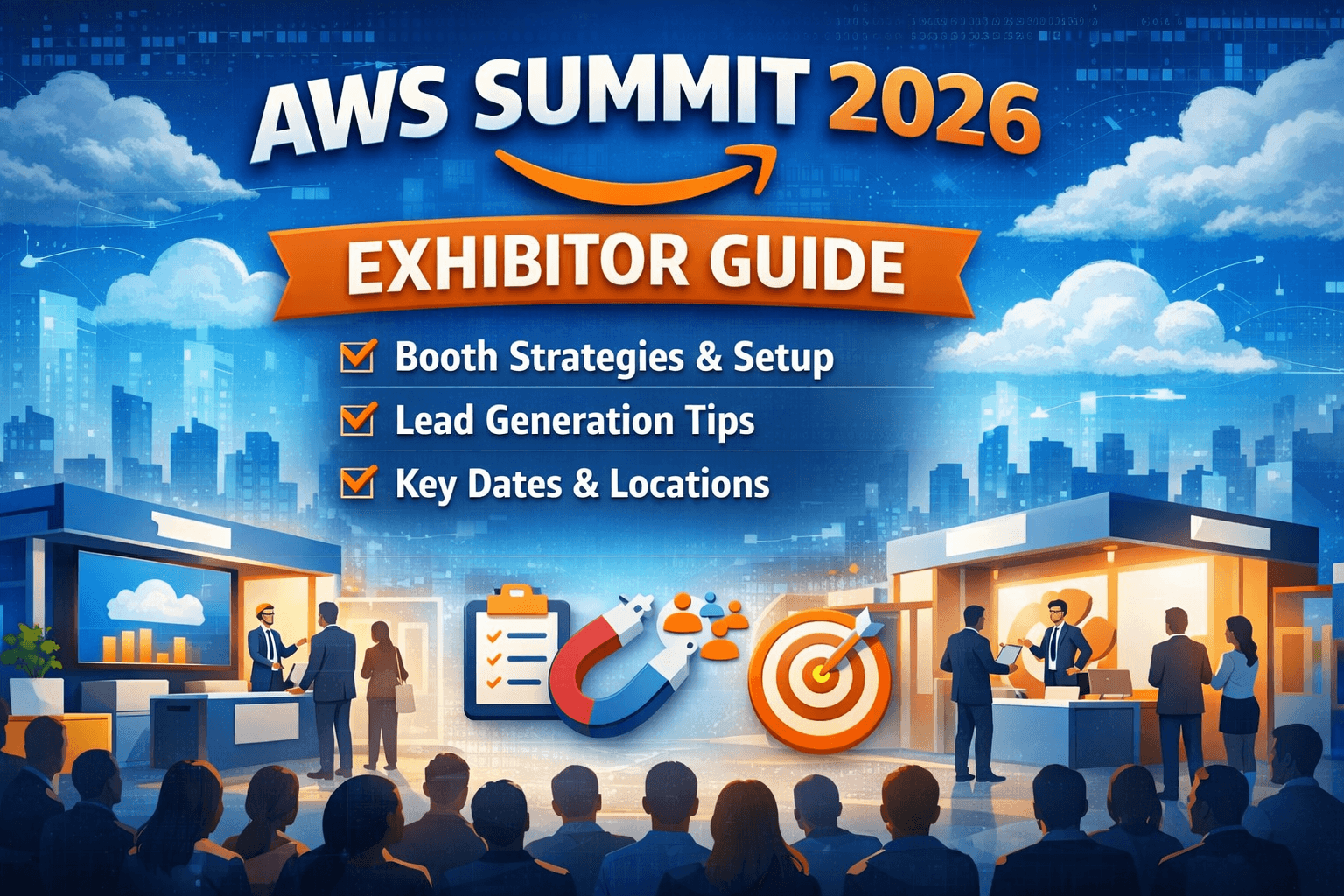
AWS Summit isn't one event — it's a global series of free, single-day cloud conferences that AWS runs in more than 20 cities each year, from London and New York to Singapore, Hamburg, and Tokyo. For exhibitors, that creates a year-round calendar of concentrated buyer environments: each Summit packs thousands of developers, architects, and enterprise cloud decision-makers into a single expo hall for one high-intensity day.
This guide is built for exhibitors deciding which AWS Summit to invest in and how to turn a single day on the floor into pipeline. It covers the confirmed 2026 city dates (kept current below), how to choose the right Summit for your goals, and the booth, staffing, lead-generation, and ROI tactics that actually work with a technical AWS audience. Last updated: June 2026.
AWS Summit 2026 Dates and Locations
AWS Summits run throughout the year across every major region. The table below tracks the 2026 editions we cover in depth — each links to a full show page with venue details, attendee data, and exhibitor information. Status is shown as of June 2026; AWS continues to announce additional cities (Sydney, Toronto, Washington D.C., Paris, Mumbai, São Paulo, and more) throughout the year on the official AWS Summits page.
| AWS Summit 2026 | Date | Venue | City | Status |
|---|---|---|---|---|
| AWS Summit London 2026 | Apr 22, 2026 | ExCeL London | London, UK | Completed |
| AWS Summit Singapore 2026 | May 6, 2026 | Marina Bay Sands | Singapore | Completed |
| AWS Summit Hamburg 2026 | May 20, 2026 | Hamburg Messe und Congress | Hamburg, DE | Completed |
| AWS Summit New York 2026 | Jun 17, 2026 | Jacob K. Javits Center | New York, US | Completed |
| AWS Summit Japan 2026 | Jun 25–26, 2026 | Makuhari Messe | Chiba/Tokyo, JP | Upcoming |
If your target Summit has already passed, treat it as your reconnaissance for 2027 — sponsorship sales for the next cycle open within weeks of each event, and early commitments secure the best booth locations. For the upcoming AWS Summit Japan 2026 (the largest in the series, with around 30,000 attendees expected across two days at Makuhari Messe), there is still time to plan a strong on-floor presence.
Which AWS Summit Should You Exhibit At?
Because the Summits are free and regional, each one over-indexes on a particular buyer mix. Picking the right city matters more than picking the biggest one. A few rules of thumb:
- Enterprise and Fortune 500 reach → AWS Summit New York draws one of the largest enterprise buyer pools of any Summit, heavy in fintech, media, and healthcare. Around 25,000 attendees in a single day.
- EMEA market entry → AWS Summit London is the season's flagship European Summit and a strong entry point for exhibitors targeting UK and Western European cloud spend.
- DACH and German-speaking markets → AWS Summit Hamburg is more focused (around 6,000 attendees) but high-intent for vendors selling into German enterprises and the Mittelstand.
- APAC and Southeast Asia → AWS Summit Singapore is the regional hub for ASEAN cloud adoption, public sector, and financial services.
- Largest audience and APAC scale → AWS Summit Japan is the biggest single Summit on the calendar and the gateway to one of the world's most sophisticated cloud markets.
The smartest exhibitors don't try to do all of them. They pick the one or two Summits where their ideal customer profile is densest, go deep, and reuse the booth assets and playbook across cities.
What Makes AWS Summits Different From Other Cloud Trade Shows
AWS Summits are free-to-attend and almost always single-day. That single fact reshapes your entire exhibiting strategy, because it changes who walks the floor.
Unlike paid conferences where a high ticket price pre-qualifies the audience, Summits attract an extremely broad mix — C-suite executives evaluating cloud migration, platform engineers comparing tools, solutions architects scoping a build, and junior developers there for the hands-on labs. You get volume and variety, but far less pre-qualification than a paid event like Google Cloud Next or Microsoft Ignite.
For exhibitors, that means your booth has to qualify and convert at speed. You're not at a boutique event with 500 hand-picked attendees and a relaxed agenda. You're on an expo floor where thousands of people pass your booth in a matter of hours, and where a single missed connection can't be recovered the next day — because there is no next day.
The typical Summit agenda includes keynotes, breakout sessions across multiple tracks (AI/ML, security, serverless, data analytics, migration), hands-on labs, and the expo hall. The expo hall is where sponsors and AWS Partner Network (APN) members showcase solutions, run live demos, and capture leads. Because the audience skews technical, the expo floor rewards substance over spectacle: working demos beat glossy banners every time.
Booth Planning: What to Get Right Before You Ship Anything
Your exhibitor kit — provided by AWS once your sponsorship is confirmed — is the single most important document you'll receive. It contains move-in schedules, floor-plan assignments, electrical and AV specifications, badge policies, shipping addresses, and submission deadlines. Read it the day it arrives, and calendar every deadline immediately. Missing an early-bird deadline for electrical or rigging can cost you both money and your preferred setup.
Here are the practical considerations that catch first-time AWS Summit exhibitors off guard:
Storage is nonexistent. At many Summit venues — AWS Summit London at ExCeL is a known example — there is no additional storage within the expo hall. All marketing collateral, swag, and demo equipment must fit within your booth footprint. Ship only what you need, and design your booth so cases double as furniture or hide under counters.
Security is general, not personal. AWS typically provides 24-hour event security, but assumes no responsibility for exhibitor equipment or property. Never leave laptops, tablets, or high-value demo hardware unattended during setup, the show, or overnight. Bring lockable cases.
Badges are non-transferable. Every person entering the expo — including during setup and breakdown — needs a registered badge. You cannot hand your badge to a colleague or a local contractor. Plan your staffing roster early and register everyone in advance.
Connectivity is your responsibility. Do not rely on venue Wi-Fi for a live demo in front of a prospect. Order a hardwired line through the exhibitor kit, bring a dedicated cellular hotspot as backup, and cache anything you can run offline. A demo that buffers in front of a senior architect is worse than no demo at all.
The seven-second rule applies. Attendees walking the floor give your booth roughly seven seconds before deciding whether to stop. Your primary message must be legible from 10 meters away and immediately relevant to the visitor's problem. Don't lead with your company name in giant letters — lead with the outcome you deliver or the pain you remove ("Cut your S3 bill 40%", not "Acme Cloud Solutions").
Staffing Your Booth: Quality Over Headcount
The people standing in your booth matter more than the graphics behind them. The best Summit booth staff combine genuine product depth with conversational skill — they can qualify a prospect in under two minutes, pivot the pitch based on the visitor's role, and capture contact details without breaking the flow.
A common mistake is sending your most senior executives to staff the booth full-time. Executives should rotate through for key meetings and VIP walk-ups, but your booth's core crew should be solutions engineers and sales-development reps who thrive in high-volume, face-to-face environments. At a technical event, attendees can tell within seconds whether the person across the table actually understands their architecture — so staff for credibility, not just charisma.
Aim for a staffing ratio of two to three people per 10 square meters of booth space. For a standard sponsor booth at a Summit, that usually means three to four staff per shift, rotating every two to three hours to keep energy high. Brief the whole team the night before on the qualifying questions, the demo flow, the lead-capture process, and who handles which type of conversation.
Lead Generation Strategy: Move Beyond Badge Scanning
Here's a statistic worth building your strategy around: 72% of exhibitors attend trade shows primarily for lead generation (Trade Show Labs, 2026). But the industry is shifting away from raw volume. The metric that mattered in 2024 — total badge scans — is being replaced by engagement quality, with marketers increasingly measuring "return on relationships" rather than lead count.
At an AWS Summit, that shift is even more pronounced because the audience is technical. Developers and architects engage with live product demos and hands-on content; they disengage instantly from a generic sales pitch delivered from behind a table of branded pens.
Practical lead-gen tactics that work with an AWS crowd:
Run a live demo on a loop. If your product integrates with core AWS services — Lambda, SageMaker, Bedrock, S3, EKS — show it working in real time. A tight 3-minute demo cycle running continuously draws more qualified traffic than any banner.
Offer a hands-on challenge. Summit attendees are builders. A 5–10 minute mini-lab or coding challenge at your booth gives them something to do — and participants hand over contact details to take part, so you get a lead who has already engaged with your product.
Capture context, not just contacts. The moment you scan a badge, add a note: what the visitor asked about, their current stack, and where they are in the buying cycle. A badge scan with no context is nearly worthless to your sales team on Monday.
Qualify with a simple framework. Train staff on a lightweight version of BANT or MEDDIC so they can tier leads on the spot — hot, warm, or nurture — and tag them in your capture tool. This makes post-show follow-up dramatically faster and more accurate.
Book follow-up meetings on-site. Don't wait for the post-show email. If a conversation is going well, put a 15-minute meeting on the calendar right there. Meetings booked at the event convert far better than cold post-show outreach.
Choose swag a technical buyer actually keeps. Skip the stress balls. High-quality stickers, well-designed t-shirts, and genuinely useful items (good notebooks, quality cables, power banks) get used — and keep your brand in front of the buyer long after the floor closes.
The Pre-Show Work That Separates Top Exhibitors
The most successful exhibitors don't wait until event day to start generating value. In the four to six weeks before the Summit:
Announce your presence. Post on LinkedIn that you'll be exhibiting, share your booth number, and invite existing pipeline contacts to stop by. Tag the official AWS Summit account for added visibility.
Book pre-scheduled meetings. Use the event's matchmaking platform (if available) or reach out directly to target accounts you know will attend. Walking into the Summit with 10–15 pre-booked meetings transforms your ROI before the doors even open.
Prepare your post-show content in advance. Write your follow-up email sequences, draft a recap blog post, and plan to record short video testimonials at the booth while energy is high. All of it should be ready to deploy within 48 hours of the event ending.
Budget and ROI: What the Numbers Say
Trade show exhibiting is a significant investment, but the returns — when executed well — justify it. The average cost per lead generated at a trade show is $112, and converting a trade show lead is 38% less expensive than relying on outbound sales calls alone (Cvent, 2025). Among Fortune 500 companies that treat events as a core channel, 14% report a 5:1 ROI from trade show exhibiting.
For AWS Summits specifically, costs vary by city and sponsorship tier, but standard sponsor booths are substantially cheaper than a full re:Invent sponsorship — making Summits an accessible entry point for mid-market SaaS companies and regional AWS partners. If you're an APN member, ask your AWS partner manager about co-marketing opportunities; some Summit sponsorships are partially subsidized for qualifying partners, and Marketing Development Funds (MDF) can offset booth and travel costs.
Build your budget around four categories: booth costs (space, design, shipping), travel and accommodation, staff time, and post-show follow-up. Most exhibitors underinvest in that last category. Allocate at least 20% of your total event budget to post-show nurture — personalized follow-up, demo scheduling, and content delivery — because that's where one-day conversations turn into closed deals.
A simple way to sanity-check your spend: estimate the number of qualified leads you realistically expect (based on booth size, traffic, and staffing), apply your historical lead-to-opportunity and opportunity-to-close rates, and multiply by average deal size. If the projected pipeline doesn't comfortably clear your all-in cost, either rework the plan or pick a different Summit where your ICP is denser.
After the Show: The 48-Hour Window
What you do in the 48 hours after a Summit determines whether the leads convert or go cold. The audience moves fast, attends multiple events, and forgets booths quickly — so speed wins.
- Segment leads the same night. Use the hot/warm/nurture tiers your staff assigned on the floor. Hot leads get a personal email or call within 24 hours; warm leads enter a tailored sequence; the rest go to nurture.
- Personalize with the context you captured. Reference the specific thing the prospect asked about. "Following up on the Bedrock cost question you raised at our booth" outperforms a generic "great to meet you" every time.
- Hand off cleanly to sales. Make sure every hot lead lands in your CRM with notes, tier, and next step — not in a spreadsheet someone forgets to import.
- Measure engagement quality, not just volume. Track demo participation, meetings booked, and pipeline created — the "return on relationships" metrics — alongside raw scan counts. That's what tells you whether a given Summit is worth repeating.
AWS re:Invent: The Anchor Event
While Summits are the regional plays, re:Invent remains the anchor of the AWS ecosystem — a multi-day flagship held annually in Las Vegas late in the year, drawing tens of thousands of in-person attendees and millions of livestream viewers. It commands a far larger expo floor and a deeper, more committed audience than any single Summit.
If the Summits are your qualifying rounds, re:Invent is the final. Use your 2026 Summit exhibiting experience to refine your messaging, booth design, and staffing model before committing to the larger re:Invent investment. For the full slate of cloud and technology events, see the TradeshowBuzz Event Directory.
Next Steps for Exhibitors
Start with the Summit closest to your target market, commit early enough to secure a good booth location, and build the pre-show, on-floor, and post-show playbook described above. If your target city has already run this year, use the show page to study the event and lock in your plan for the 2027 cycle.
For a full list of upcoming cloud and technology trade shows — including every AWS Summit, re:Invent, and competitor events like Google Cloud Next and Microsoft Ignite — browse the TradeshowBuzz Event Directory. And if you need booth builders, AV providers, or logistics partners who specialize in tech trade shows, check the TradeshowBuzz Vendor Directory to compare options.
FAQs
When are the AWS Summit 2026 dates?
AWS Summit 2026 runs as a global series across more than 20 cities. Key 2026 editions include London (April 22), Singapore (May 6), Hamburg (May 20), New York (June 17), and Japan/Tokyo (June 25–26), with additional cities announced throughout the year on the official AWS Summits page. See the dates table above for venues and links to each city's show page.
Which AWS Summit is best for exhibitors?
It depends on your target market. AWS Summit New York offers the largest enterprise buyer pool, London is the European flagship, Singapore is the APAC hub, Hamburg targets German-speaking markets, and AWS Summit Japan is the single largest Summit by attendance. Choose the one or two cities where your ideal customer profile is densest rather than the biggest event overall.
What does it cost to exhibit at AWS Summit 2026?
AWS Summit sponsorship costs vary by city and package, but standard exhibitor booths are generally far more affordable than large conferences like re:Invent. Costs typically cover booth space, branding, and a limited number of passes; travel, shipping, and staffing are additional. APN members may qualify for co-marketing support or Marketing Development Funds.
Is AWS Summit worth it for exhibitors?
Yes. AWS Summits offer high foot traffic and access to a broad mix of decision-makers, developers, and cloud professionals. The audience is less pre-qualified than at paid events, so ROI depends on a strong booth strategy, fast on-floor qualification, and disciplined 48-hour follow-up.
How many attendees come to AWS Summits?
Attendance varies widely by city. Smaller Summits like Hamburg draw around 6,000 attendees, while flagship events like New York (~25,000) and Japan (~30,000) attract far larger single-day crowds. AWS re:Invent, the multi-day flagship, draws tens of thousands globally.
What is the best strategy to generate leads at AWS Summit?
Run live product demos, offer a hands-on challenge or mini-lab, and engage attendees with technical content rather than a generic pitch. Capture context alongside every badge scan, qualify leads into hot/warm/nurture tiers on the spot, and book follow-up meetings on-site to significantly improve conversion.
How should I prepare my booth for AWS Summit?
Focus on a clear, outcome-led message visible within seconds, a compact booth design (storage is limited at many venues), and reliable connectivity for live demos. Read your AWS exhibitor kit the day it arrives, calendar every deadline, and make sure your value proposition is immediately relevant to a technical cloud audience.
How many staff members should be at an AWS Summit booth?
A good rule of thumb is two to three staff per 10 square meters of booth space — typically three to four people per shift for a standard booth, rotating every two to three hours. Prioritize solutions engineers and SDRs with real product depth over senior executives, who should rotate in for key meetings.
Are AWS Summits better than Google Cloud Next or Microsoft Ignite?
AWS Summits are free, single-day, high-volume events ideal for broad exposure across a technical audience. Google Cloud Next and Microsoft Ignite are paid, multi-day events with more pre-qualified attendees. The best choice depends on which platform's ecosystem your buyers live in and whether you want reach or pre-qualification.
When should exhibitors start planning for AWS Summit?
Begin at least 8–12 weeks before the event: book the booth, prepare marketing materials and demos, schedule meetings with target accounts, and build your post-event follow-up campaigns. Booth locations and early-bird exhibitor-kit deadlines reward early commitment.
How can I maximize ROI from AWS Summit exhibiting?
Pick the right city for your ICP, walk in with 10–15 pre-booked meetings, run engaging on-floor demos, and follow up within 48 hours. Allocate at least 20% of your budget to post-show nurture and measure engagement quality — demos, meetings, and pipeline — instead of raw lead volume.