Hannover Messe 2026 Recap: Key Highlights, Trends & Takeaways for Manufacturers
Hannover Messe 2026 brought 2,900 exhibitors and one clear message: industrial AI is now applied, not aspirational. Inside the recap, the trends, and takeaways for 2027.
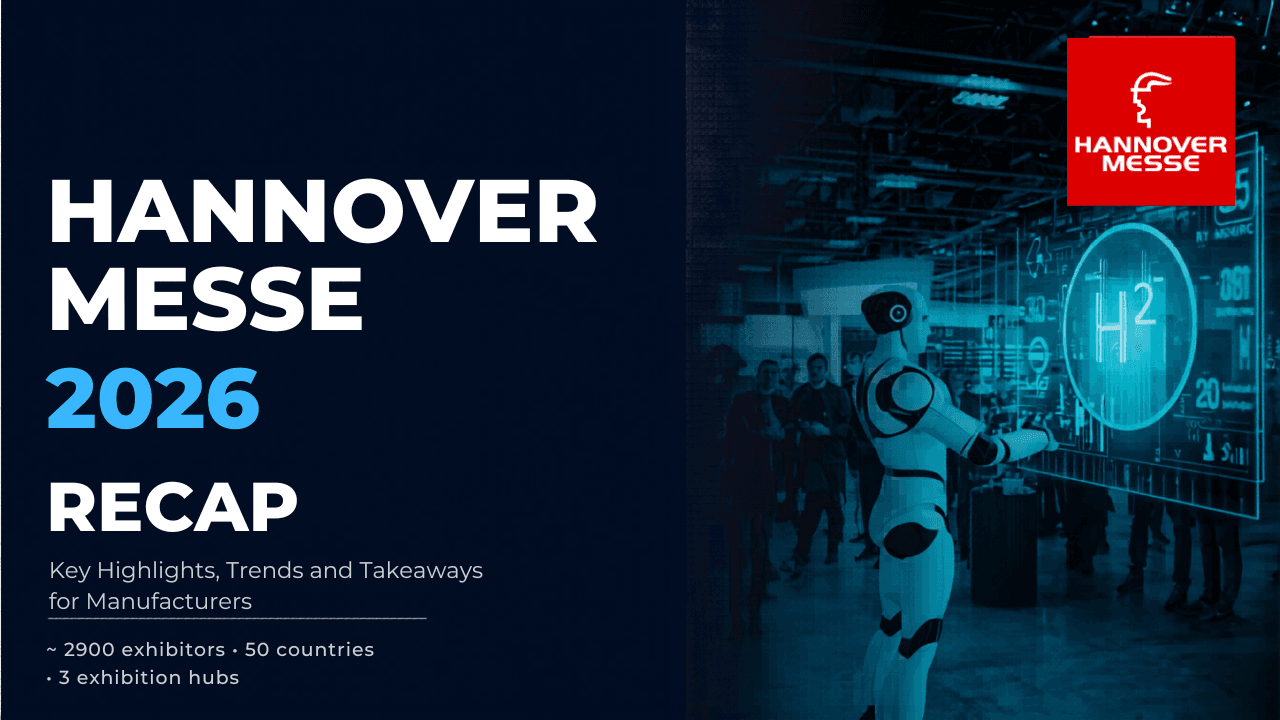
Hannover Messe 2026 Recap: Key Highlights, Trends & Takeaways for Manufacturers
Hannover Messe 2026 was one of the world's largest industrial trade shows, focused on applied industrial AI, robotics, and energy infrastructure, with over 2,900 exhibitors from 50+ countries.
For five days in April, Hannover Messe traded its usual future-facing posture for something more practical. The show has spent the last decade promising what AI could do for manufacturing. The 2026 edition, which ran April 20–24 in Hannover, Germany, was the first to be built around what AI is actually doing — right now, in real factories, on real production lines.
That shift framed everything else. Around 2,900 exhibitors from more than 50 countries showed up under the banner "Think Tech Forward," and the storylines that compounded across the week were unmistakable: deployed industrial AI replacing roadmap slides, humanoid robots moving from research labs to production-ready demos, and a Brazilian partner-country presence that came with real trade weight behind it.
Here are the key highlights from Hannover Messe 2026, the trends that defined the week, and the takeaways every exhibitor, marketer, and manufacturer should carry into 2027 planning.
Hannover Messe 2026 at a Glance
- 📍 Location: Hannover, Germany
- 📅 Dates: April 20–24, 2026
- 🏭 Exhibitors: ~2,900+
- 🌍 Countries: 50+
- 🤖 Headline trends: Industrial AI, humanoid robots, hydrogen, automation
- 🌎 Partner country: Brazil
- 🎯 Show motto: Think Tech Forward
- 🏛️ Exhibition hubs: Automation & Digitalization · Energy & Industrial Infrastructure · Research & Technology Transfer
What were the key highlights of Hannover Messe 2026?
The key highlights from Hannover Messe 2026 included the shift from AI demos to real-world deployment, the arrival of humanoid robots as a serious industrial category, strong participation from Brazil as the official partner country, and growing commercial momentum in hydrogen and energy infrastructure. The show drew around 2,900 exhibitors from more than 50 countries under the "Think Tech Forward" motto, and was opened by German Chancellor Friedrich Merz alongside Brazilian President Luiz Inácio Lula da Silva.
A presidential opening set the tone
Day one was Monday, April 20, and the opening ceremony brought heavyweights to the stage. German Chancellor Friedrich Merz officially opened the show alongside Brazilian President Luiz Inácio Lula da Silva, whose country took the partner-country slot for 2026.
Merz didn't waste the keynote on platitudes. AI, he said, is "profoundly reshaping economic activity," and the industrial sector is where the productivity gains, resource efficiency, and cost reductions actually compound. He then sat down with a panel of DAX CEOs — Siemens' Roland Busch, SAP's Christian Klein, and Deutsche Telekom's Tim Höttges — to discuss how to scale AI across European industry without leaving mid-tier manufacturers behind.
The frame the show wanted you to take home:
- "Application, application, application" — Show Director Jochen Köckler's opening-morning mantra
- AI as a procurement line, not a roadmap promise
- Mid-tier manufacturer adoption as the next battleground
When a sitting Chancellor lectures CEOs about deployment on Monday morning, the rest of the week's editorial frame is locked in by lunchtime.
Industrial AI at Hannover Messe 2026: From Demo to Deployment
The single biggest shift at Hannover Messe 2026 was tonal. Vendors stopped pitching AI as a roadmap item and started showing line-item SKUs.
Microsoft used the show to push its industrial cloud and shop-floor copilots, with use cases focused on predictive maintenance and supply-chain optimization rather than generic productivity. Siemens rolled out updates to its Industrial Copilot — narrower, more domain-specific, and built for engineers who don't have time to prompt-engineer their way through a maintenance window. SAP and PTC anchored their booths around live demos rather than slideware; PTC, in particular, leaned into Onshape and Windchill workflows already in customer hands. Capgemini's pavilion focused on integration — the unsexy but expensive work of wiring production AI into ERP, MES, and quality-management stacks.
The throughline across all of them was the same: real-world AI use, on real plants, with named customers. Hannover Messe 2026 was the year operational AI moved out of the innovation-theater zone and into the procurement conversation. For anyone evaluating an industrial AI strategy of their own, the takeaway is that the case studies you cite need to be customer-facing, not internal pilots.
The contrarian take: The most important takeaway from Hannover Messe 2026 isn't that AI is being adopted — it's that buyers now assume it is. Vendors without a deployment story weren't just overlooked. They were ignored.
For marketers selling into manufacturing, that's a meaningful tonal shift. Buyers walked the floor expecting deployment proof, not vision decks.
👉 Planning your 2027 strategy? See our complete Hannover Messe Exhibitor's Guide →
Humanoid robots stole the show floor
The buzziest booths of the week weren't selling software. According to floor reports from Deutsche Messe and trade-press coverage, around 15 humanoid robotics companies presented production-ready systems — and Hannover Messe gave them serious floor space for the first time, signalling that humanoids have crossed from research curiosity to industrial product category.
A standout was Agile Robots' debut of Agile One, reported by show coverage as one of the densest-trafficked single booths of the week. Other humanoid exhibitors leaned into specific industrial use cases:
- Material handling — pick-and-place where conveyor automation falls short
- Last-meter logistics inside factories — bridging dock to line
- Inspection tasks in environments unsafe for people
- Teleoperated maintenance in high-mix, low-volume cells
Notably absent: the general-purpose home-assistant framing that's dominated humanoid coverage in consumer media. This was industrial — narrowly scoped, narrowly priced.
For event marketers, the takeaway is straightforward: humanoids are now a way to drive booth traffic. Expect 2027 to lean harder into this, and expect competitors without a robotics story to feel the absence by mid-week.
👉 Want booth ideas that drive traffic? Calculate your trade show ROI before you commit →
Brazil's partner-country debut had teeth
Partner-country slots at Hannover Messe usually trade in soft diplomacy. Brazil treated 2026 as trade infrastructure.
Lula's personal attendance signalled that the partner-country slot wasn't a goodwill gesture; it was leverage. Brazilian exhibitors showed up with substance across:
- Agritech — precision farming and supply-chain digitization
- Mining — automation and sustainability tech for critical minerals
- Renewable energy — biofuels, wind, solar manufacturing
- Advanced manufacturing — automotive components, aerospace tier-2
These are precisely the sectors where the Mercosur–EU corridor has been moving toward formal trade agreements for years and finally has political momentum. The pavilion programming reflected the strategy: country nights, business forums, signed memoranda of understanding, follow-on commercial agreements.
For European exhibitors, the implication is clear — if Latin America is on your 2027 expansion map, the relationships built in those Brazilian pavilion meetings will be the ones that pay off. For marketers, it's a reminder that partner-country slots, when used aggressively, are one of the best lead-gen instruments in trade-show land.
The three-hub format actually worked
Hannover Messe 2026 introduced a simplified three-hub layout:
| Hub | What it covered | 2026 verdict |
|---|---|---|
| Automation & Digitalization | Smart manufacturing, robotics, AI, digital platforms, cybersecurity | Expected centre of gravity. Densely trafficked. |
| Energy & Industrial Infrastructure | Hydrogen, electrification, grid technology, sustainable power | The week's surprise — visitor density rivalled the AI halls. |
| Research & Technology Transfer | Breakthrough innovations, science-to-industry collaboration | The seedbed for next year's headliners, as usual. |
The Energy hub was the standout. Hydrogen and electrification booths felt closer to commercial deployment than at any prior edition — less greenwash, more grid integration, more practical hardware.
Practical takeaway for 2027 exhibitors: pick your hub deliberately. Cross-hub booths got lost. The hub framing channels visitor flow, and a vague positioning statement gets read as filler.
Hannover Messe 2026 vs 2025: What Changed
If you exhibited or attended in 2025, here's where 2026 felt different:
- AI moved from concept to deployment. Last year's "AI for manufacturing" track was vision-heavy. This year it was customer-named.
- Humanoid robotics got dedicated floor space for the first time — a category that was niche curiosity in 2025 became a magnet category in 2026.
- Energy hub gained substance. 2025's hydrogen story was largely speculative; 2026 booths showed grid-scale and commercial-scale deployments.
- Partner-country presence intensified. Brazil came with state-level political support and signed agreements, not just a pavilion.
- Buyer intent appeared stronger. Several exhibitors and floor reports suggested fewer casual visitors and more buyers walking the floor with active RFPs compared with 2025.
Net: 2026 was a consolidation year, not a reveal year. The trends weren't new — but they crossed the line from "interesting" to "operational."
The numbers that mattered
According to Deutsche Messe official figures, Hannover Messe 2026 hosted around 2,900 exhibitors from more than 50 countries, confirming its position as one of the world's largest industrial trade shows. Across the floor, roughly 3,000 companies showed applied AI, robotics, automation, and digitalization solutions.
The figure worth pausing on: Chinese exhibitors reportedly accounted for roughly 700 companies — the second-largest national delegation after host country Germany. That's geopolitically loaded given the EU's current tariff posture, and it underlines a pragmatic truth: for industrial buyers, the China supply base is still where a lot of the hardware actually comes from, regardless of policy noise.
Beyond the totals, the qualitative story was about decision-maker density. Several exhibitors and floor reports suggested stronger buyer intent compared with previous years — fewer casual visitors, more active-RFP conversations.
Logistics: the transit strike was a Day-1 stress test
A logistics note for anyone budgeting for 2027. Local press and Deutsche Messe communications confirmed that the ver.di union called a warning strike on April 20–21, suspending tram lines and most local bus routes through opening morning. For a show that depends on tens of thousands of attendees moving between hotels and the fairgrounds before 9am, that's a real disruption.
The show appears to have recovered by mid-week with expanded shuttle service and ride-share absorption, and final attendance figures haven't been reported as materially affected. But the lesson stands: when you're planning your 2027 booth budget, build in transit contingency. Hannover's labour environment isn't getting calmer.
What Exhibitors Should Do Differently for 2027
The 2026 floor sent clear signals about what works and what doesn't. Here's the short tactical list for anyone booking 2027 space:
- Invest in live demos over presentations. Slideware lost the week; running systems won it.
- Build a clear AI deployment story. Customer logos, integration partners, deployment timelines. Not vision slides.
- Add a robotics or automation element to your booth — even if it's not core product. It's now a traffic strategy.
- Align with one clear hub. Automation, Energy, or R&T. Hybrid positioning gets read as filler.
- Pre-book meetings with target regions — Latin America (especially via the Brazilian network) and EU mid-tier manufacturers.
- Plan for transit contingency. Strike-resilient travel and shuttle access for your team.
- Run an ROI projection before you sign the floor-space contract.
Related Trends in Industrial Trade Shows
Hannover Messe 2026 sits inside a broader set of shifts moving across industrial trade shows globally:
- Industrial AI adoption in manufacturing — moving from pilot programs to plant-wide deployments
- Robotics in factory automation — humanoids, AMRs, and collaborative systems converging on real production lines
- Hydrogen infrastructure growth in Europe — commercial-scale electrolyzer projects, grid integration, and offtake agreements
- Smart manufacturing and Industry 4.0 — finally exiting buzzword status into operational architecture
- Geopolitics on the show floor — partner-country slots, tariff posture, and re-shoring incentives reshaping exhibitor mix
If you're benchmarking 2027 trade show strategy across multiple events, these are the throughlines to watch.
What it means for manufacturing in 2026
Five takeaways from the week, compressed:
- AI is a budget line, not a pilot. Procurement conversations, not roadmaps. Marketers selling into manufacturing should retire the "future of work" framing.
- Humanoids are booth-strategy table stakes. If your 2027 booth doesn't have a robotics narrative, the silence will register.
- Latin America is open for business. The Mercosur corridor matters. Plan accordingly.
- Energy storylines have substance. Hydrogen and electrification are leaving the "vision" phase. Sustainability messaging that points to grid integration or commercial-scale deployment will outperform vague net-zero copy.
- The three-hub format channels attention. Pick a hub deliberately when you book 2027 floor space. Hybrid booths got lost in 2026 — that won't change.
Hannover Messe 2026 wasn't a year of dramatic reveals. It was a year of consolidation — proof that the trends industrial-tech marketers have been writing about for five years are now operational. Hannover Messe 2026 made one thing clear: industrial buyers are no longer buying vision — they are buying execution. For exhibitors planning Hannover Messe 2027, the strategy is simple: bring product, bring customers, bring proof.
FAQs: Hannover Messe 2026
What were the main highlights of Hannover Messe 2026?
The standout highlights from Hannover Messe 2026 were the shift from AI demos to live AI deployments, dedicated floor space for production-ready humanoid robots, Brazil's substantial partner-country presence, and the Energy hub's hydrogen and electrification surge.
How many exhibitors attended Hannover Messe 2026?
Around 2,900 exhibitors from more than 50 countries participated in Hannover Messe 2026. Chinese exhibitors reportedly accounted for roughly 700 companies, making it the second-largest national delegation after Germany.
What was the theme of Hannover Messe 2026?
The official theme was "Think Tech Forward," with Show Director Jochen Köckler emphasizing applied industrial deployment over conceptual demos: "Application, application, application."
Who was the partner country for Hannover Messe 2026?
Brazil was the official partner country for Hannover Messe 2026. Brazilian President Luiz Inácio Lula da Silva attended the opening alongside German Chancellor Friedrich Merz, with Brazilian exhibitors leading on agritech, mining, renewable energy, and advanced manufacturing.
What industries are represented at Hannover Messe?
Hannover Messe covers manufacturing, industrial automation, robotics, AI, hydrogen and electrification, grid infrastructure, research and technology transfer, and the supplier ecosystems serving them.
Is Hannover Messe worth attending for exhibitors?
Yes — Hannover Messe is one of the most important global industrial trade shows, offering high-quality buyer interactions, strong international exposure, and opportunities for partnerships and expansion. The 2026 edition appeared to attract stronger buyer intent, with exhibitors reporting more active-RFP conversations and fewer casual visitors compared with 2025.
When is Hannover Messe 2027?
Hannover Messe 2027 dates have not yet been confirmed by Deutsche Messe. The show typically runs the third or fourth week of April. Exhibitors planning 2027 should monitor the official Hannover Messe site for date confirmation.
What to Expect at Hannover Messe 2027
Predictions, ranked by confidence:
- Deeper AI integration into core manufacturing systems. Expect ERP, MES, and PLM vendors to lead with embedded AI rather than bolt-on copilots.
- Robotics expansion beyond humanoids. Mobile manipulators, autonomous mobile robots (AMRs), and collaborative arms with new safety profiles will share the spotlight.
- Stronger energy infrastructure commercialization. Hydrogen will be sold by the cubic metre, not by the slide deck. Expect signed offtake agreements as booth backdrops.
- Increased geopolitical influence on exhibitor mix. EU tariff posture, US re-shoring incentives, and the Mercosur corridor will all visibly shape who gets which hall.
- Sustainability messaging will need teeth. Generic net-zero claims will draw less interest than specific grid-integration and circular-supply-chain stories.
For anyone planning a 2027 booth, the strategic move is to position now around one of these throughlines — not all of them.
Planning for Hannover Messe 2027?
If you're exhibiting or evaluating ROI, don't rely on guesswork.
- 👉 Use our Trade Show ROI Calculator to project booth performance before you commit
- 👉 Read the Hannover Messe 2026 Exhibitor's Guide for booth selection, pavilion strategy, and timeline
- 👉 Learn how to measure trade show ROI before you set your 2027 budget
Publishing notes
- Author byline: the article page header already renders author name, avatar, and published date from
articles.author_name/author_avatar_url/published_at(seesrc/app/articles/[slug]/page.tsx). Don't add a duplicate byline inside the markdown body — set the DB fields instead. Suggested:author_name = "TradeShowBuzz Editorial Team",published_at = 2026-04-28. - Featured image: wide opening-ceremony shot OR humanoid-robot-in-factory hybrid visual (Discover-friendly). Source from Deutsche Messe press kit.
- Category: Industry News / Trade Show Recaps
- Tags: hannover messe, industrial AI, humanoid robots, manufacturing, trade show recap, industry trends, brazil, hydrogen, smart manufacturing
- Internal links — verify status before publish:
- ✅
/articles/hannover-messe-2026-exhibitors-guide— companion (currently inreview— must publish first) - ✅
/resources/roi-calculator— exists atsrc/app/resources/roi-calculator/page.tsx - ✅
/articles/trade-show-roi-how-to-measure-what-actually-matters— also in drafts; needs to be published - 🗒️
/articles/industrial-ai-in-manufacturingand/articles/how-to-attract-visitors-to-your-trade-show-booth— REMOVED in v5 (audit reaffirmed broken links = SEO damage). Both remain strong future cluster targets — recommend creating these as separate ticketed articles, then revisiting this recap to re-add the links once they exist. /shows/hannover-messe— verify show record exists in DB- Auto-link will catch in-body show/city mentions
- ✅
- Outbound links:
- hannovermesse.de (official site)
- microsoft.com (industrial cloud blog)
- Schema (critical):
Article— handled by existingbuildArticleSchema()insrc/lib/utils/seo.tsFAQPage— NOT yet handled by the article page template. Biggest single SEO win — recommend a small dev follow-up to add a generic FAQPage builder for any article body containing an## FAQsection.
- First publish date: 2026-04-28