Cannes Lions 2026 Recap: Fewer Entries, Higher Stakes, and an AI That Mocked AI Ads
Cannes Lions 2026 entries fell 25.46% to 20,050 from 92 countries, down from 26,900 in 2025, after new Awards Integrity Standards introduced proof of impact, dual CEO and CMO sign-off, and bans of up to three years. Mother London took the Film Grand Prix for two Super Bowl spots that satirise ad-supported chatbots, AB InBev won the inaugural Creative Brand Lion, and Kenya and Greece won their first-ever Grand Prix. Cannes Lions 2027 runs 21-25 June 2027.
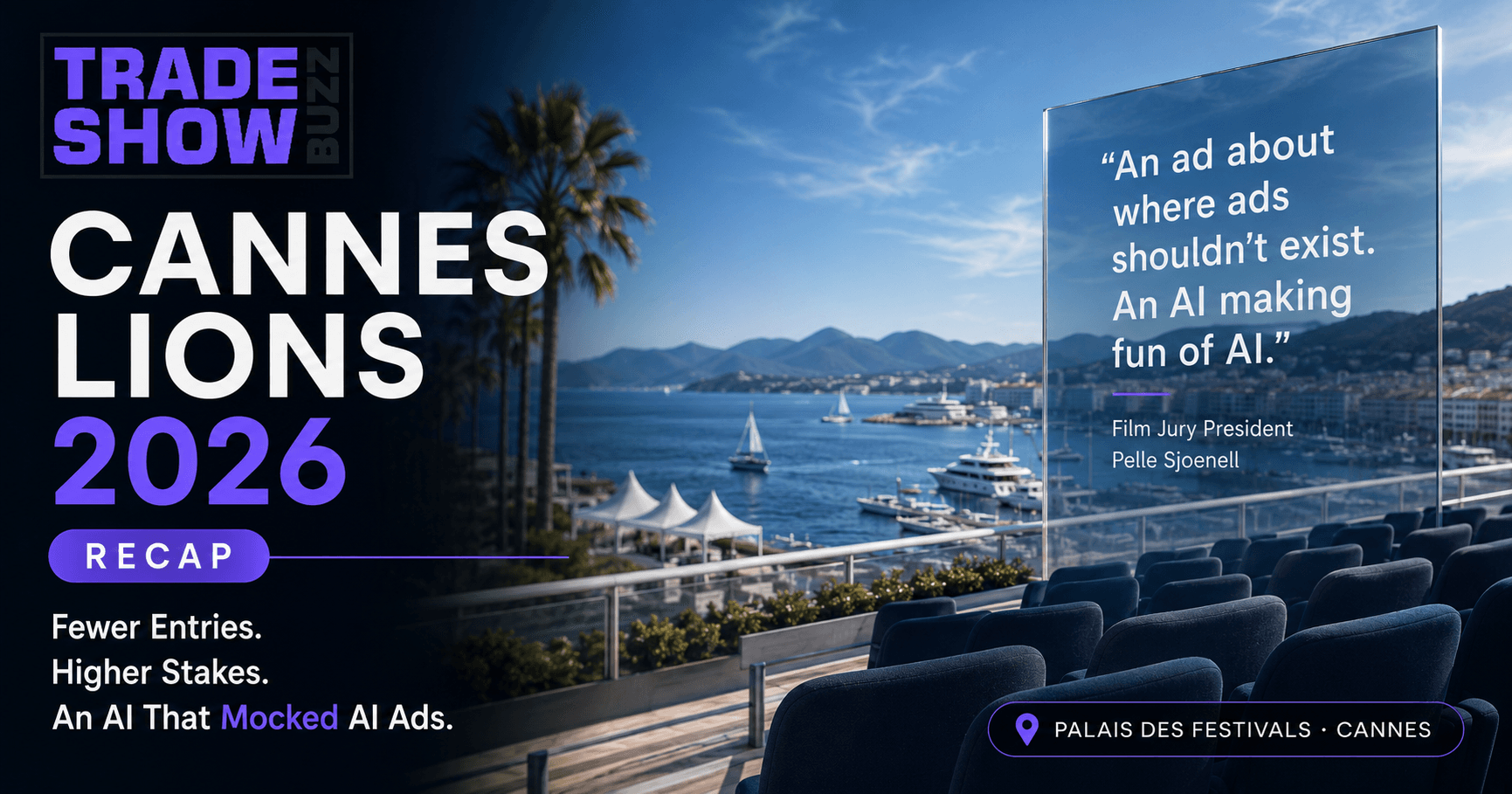
June 22-26, 2026 | Cannes, France | 73rd edition | 20,050 entries from 92 countries, down 25.5% | ~500 speakers, 150+ hours of content
The 73rd Cannes Lions 2026 International Festival of Creativity ran June 22-26 at the Palais des Festivals, and the headline number landed before a single Lion was handed out: entries fell 25.46% to 20,050, down from 26,900 in 2025. Nearly 7,000 submissions simply did not arrive.
That is not a festival in decline. It is a festival that spent a year rewriting its own rules, and the drop is the clearest evidence yet that the reset landed.
The Entry Drop Was the Point
The contraction traces directly to the 2025 scandals over fabricated case studies and "scam ads" - work engineered to win metal rather than to run in the real world, including footage doctored with AI and a fake news report. In response, LIONS introduced a set of Awards Integrity Standards for the 2026 cycle. Three changes did the work:
- Proof of impact. Every claim in a submission has to be substantiated, not asserted.
- Dual sign-off. Each entry must be personally endorsed through the Cannes Lions platform by the agency's chief executive (or whoever holds P&L responsibility) and by the client's CMO or equivalent.
- Bans with teeth. Entrants who break the rules can be barred from entering for up to three years.
The third one is what changes behaviour. A rejected entry costs an entry fee; a three-year ban costs an agency its awards pipeline, and the CEO who signed the form owns the decision personally.
LIONS CEO Simon Cook framed the standards as protective rather than restrictive: "Breakthrough work gets the recognition it deserves, while preserving the integrity that makes the recognition meaningful and enduring."
Read cynically, a 25% drop looks like a problem. Read correctly, it is a festival choosing credibility over volume. Entries still came from 92 countries, so the contraction was not a retreat by any single market. For anyone tracking the health of the awards economy, that trade is the most important development of the week.
The Film Grand Prix Was a Joke About Advertising
One of the festival's marquee awards went to Mother London for "A Time and a Place," a two-film campaign for Anthropic's Claude that debuted during Super Bowl LX - the AI company's first Super Bowl appearance. The spots, "Can I Get a Six Pack Quickly?" and "How Can I Communicate Better With My Mom?", were directed by Jeff Low through Biscuit Filmworks.
The premise is easy to get backwards. These are not ads about an assistant being helpful. They imagine a near-future in which someone asks a chatbot a genuine question about fitness or family and the answer arrives interrupted by sponsored messages. The joke is the interruption, and the target was competitors moving toward ad-supported chat - OpenAI had announced it would bring advertising to ChatGPT.
Film jury president Pelle Sjoenell put it more economically than any recap can: "An ad about where ads shouldn't exist. An AI making fun of AI."
An AI product taking one of the week's most prominent Lions, in a category judged on human storytelling, by making advertising itself the punchline, is the single sharpest signal of where the industry's head is at. The Film Lions drew 1,469 entries; this is what won.
AI Was on Every Stage, and the Framing Had Shifted
If integrity was the structural story, AI was the atmospheric one. It saturated the 150-plus hours of programming, but the register had changed from the previous two years. The recurring question was no longer whether AI would replace creative work. It was how creatives should work with it - as collaborator, production accelerant and research tool.
The programme backed that with weight rather than panels: Google DeepMind's Demis Hassabis took a Palais stage for a fireside chat on the future of creativity, alongside speakers including Stella McCartney, Meta's Nicola Mendelsohn, P&G's Marc Pritchard and Mel Robbins.
Alongside AI, the creator economy kept maturing into a board-level conversation. LIONS Creators ran for a third year in partnership with Adobe, and the rise of "creator CEOs" - individuals running media businesses off their own audiences - reframed how brands think about talent, distribution and who actually holds attention. LIONS B2B, partnered with LinkedIn, covered the other end of the same shift.
Oprah Winfrey was honoured as the 2026 Cannes LionHeart, one of the festival's highest honours.
New in 2026: A Brand Lion, a Sport Track, and a Wrap-Up Stream
Cannes used 2026 to expand its surface area in three directions.
The Creative Brand Lion launched as a new award, and it is a genuinely different thing from the rest of the Lions: it judges the client, not the campaign. Cook described it as recognising "the visionary brands that are building the systems, cultures and capabilities that make world-class creative marketing inevitable and repeatable" - inputs rather than outputs. AB InBev took the inaugural Grand Prix.
LIONS Sport launched as a content track in partnership with Sport Beach, formalising sports marketing as its own programme strand rather than something scattered across other stages. It is programming, not a new awards category; Entertainment Lions for Sport already existed and was awarded again this year.
Cannes Lions Deconstructed arrived as a new stream, capped by a live wrap-up session on Friday 26 June that gave delegates a synthesised read on the week rather than leaving them to assemble it from 500 speakers across five days.
The Winners That Defined the Week
Beyond Film, the Grand Prix spread across categories and continents:
- Design: "Apple TV Rebrand" for Apple, by TBWA\Media Arts Lab, Los Angeles.
- PR: "The KitKat Heist" for KitKat, by Burson and VML London, in Crisis Communications & Issues Management.
- Entertainment: "Original Forever" for Adidas, by Johannes Leonardo, New York, with adidas London.
- Entertainment for Music: two Grand Prix - "Original Forever" again, and "Berghain" for Rosalía ft. Björk and Yves Tumor, by CANADA.
- Dan Wieden Titanium: "Haven" for Suncorp Insurance, by Leo Australia.
- Glass: The Lion for Change: "Nigrum Corpus" for IDOMED and Instituto Yduqs, by Artplan, São Paulo.
- Media: "Build Your Own Super Bowl Commercial" for Uber Eats, by Special.
- Creative Effectiveness: "Three Words" for AXA, by Publicis Conseil, Paris.
- Film Craft: "Your Way Out" for Coinbase, by Isle of Any, New York.
- Grand Prix for Good: "600K Network" for Comando Con Venezuela, by Rainbow Lobster, Mexico City.
The KitKat win is worth pausing on, because it is the rare Grand Prix that started as a crisis. When 12 tonnes of KitKat were stolen just before Easter weekend in March 2026, the brand launched a tracker that let people scan a barcode to check whether their bar was part of the haul. It reported $224 million in earned media within ten days on zero media spend, a 31% share of voice across 93 markets, and more than 115 other brands joining in with their own jokes.
On the company honours:
- Network of the Year: Ogilvy, its third win in five years.
- Agency of the Year: LePub Milan, on the back of two Grand Prix for Heineken - "The Pub That Refused to Die" in Creative Strategy and "Could Have Been a Heineken" in Social & Creator.
- Independent Agency of the Year and Independent Network of the Year: Rethink, taking both.
- Creative Brand of the Year: Heineken, for the first time.
- Creative Marketer of the Year: AB InBev, announced ahead of the festival in May and its third time winning - the first company in Cannes Lions history to do so.
- Palme d'Or (production company): MJZ, helped by the Film Craft Grand Prix for Coinbase.
Kenya and Greece Broke Through
Two nations won their first-ever Grand Prix, and both are worth naming properly.
Kenya took the Sustainable Development Goals Grand Prix for "Paid Sick Leave for Cows," made by The Partnership Agency, Nairobi, for the dairy brand Too Good. Kenyan dairy farmers lose income when a cow is treated with antibiotics and its milk cannot be sold; the work built a mechanism to compensate them for that window. Kenya becomes only the second African nation after South Africa to win the festival's highest honour.
Greece won the Creative Business Transformation Grand Prix for "The Wedding Rice" for Wikifarmer, by McCann Worldgroup Greece, Athens.
Both are a reminder that the festival's centre of gravity keeps widening beyond the traditional London-New York axis.
By the Numbers
- 20,050 entries from 92 countries, down 25.46% from 26,900 in 2025
- ~7,000 fewer submissions year over year
- Up to 3 years - the ban a rule-breaking entrant now risks
- 1,469 entries in Film Lions, the category that produced the Claude win
- ~500 speakers across 150+ hours of content
- 2 first-time Grand Prix nations: Kenya and Greece
- 2 Grand Prix for a single campaign, Adidas's "Original Forever"
- 1 inaugural Creative Brand Lion Grand Prix, to AB InBev
- No official delegate count. LIONS did not publish attendance for 2026; the entry count is the firm figure for the edition
What It Means for the Rest of the Industry
Cannes is a leading indicator, not just a party. When the festival demands proof of impact and a CMO signature, that discipline ripples into how agencies pitch, how holding companies report creative performance and how procurement teams evaluate work - the same pressure that shapes conversations at sister events across the global trade show calendar. A 25% entry drop signals a market rewarding substance over spectacle, at least for now.
The AI story cuts the other way: it is accelerating, not consolidating. With an AI brand taking the top film prize and DeepMind on the main stage, the tools are assumed rather than debated. The open question for 2027 is whether the integrity gains hold once AI-assisted production makes it even easier to manufacture polished, plausible case studies at scale. Proof of impact is a good defence against a fabricated result. It is a weaker defence against a real result attached to work that barely ran.
The Creative Brand Lion is the quieter thing to watch. If the award that judges a client's internal systems gains status, the pressure shifts from agencies to marketing organisations - which is where most creative work actually dies.
When Is the Next Cannes Lions?
Cannes Lions 2027 runs 21-25 June 2027 in Cannes, France. Past and future editions are tracked on the Cannes Lions series page.
One clarification worth making, because the two get conflated constantly: this is the advertising and creativity festival. The Cannes Film Festival is a separate event in the same building, and it runs in May.
FAQs
When was Cannes Lions 2026 held?
The 73rd Cannes Lions International Festival of Creativity ran June 22-26, 2026 at the Palais des Festivals in Cannes, France.
Why did Cannes Lions 2026 entries fall so much?
Entries fell 25.46% to 20,050, down from 26,900 in 2025. The drop followed new Awards Integrity Standards introduced after the 2025 fabricated-case-study and scam-ad scandals. Entries now require proof of impact for every claim, personal endorsement by both the agency CEO and the client CMO, and rule-breakers can be banned from entering for up to three years.
Who won the Film Grand Prix at Cannes Lions 2026?
Mother London won the Film Grand Prix for "A Time and a Place," two Super Bowl LX spots for Anthropic's Claude: "Can I Get a Six Pack Quickly?" and "How Can I Communicate Better With My Mom?" The films satirise ad-supported chatbots. Film jury president Pelle Sjoenell described the work as "an ad about where ads shouldn't exist. An AI making fun of AI."
What were the biggest themes at Cannes Lions 2026?
Awards integrity and AI. AI ran through the programme, framed around working with it rather than being replaced by it, with Google DeepMind's Demis Hassabis on a Palais stage. New for 2026 were the Creative Brand Lion, which judges a brand's internal creative systems and went to AB InBev, plus LIONS Sport as a content track and the Cannes Lions Deconstructed wrap-up stream. Oprah Winfrey was honoured as the 2026 Cannes LionHeart.
How many people attended Cannes Lions 2026?
LIONS did not publish an official delegate count for the 2026 edition. Pre-event materials pointed at more than 12,000 delegates from over 90 countries, and third-party trackers put paid registrations at roughly 14,200 in 2025, so 2026 was likely in the low-to-mid teens of thousands. The firm figure for the edition is 20,050 award entries from 92 countries.
When is the next Cannes Lions?
Cannes Lions 2027 runs 21-25 June 2027 in Cannes, France.