
IMTS 2026 Recap: More Exhibitors, Less Floor, and a Record Crowd Density
IMTS 2026 drew 91,295 registrants from 114 countries and 1,788 exhibiting companies into 1.17 million square feet - 51 more companies in roughly 57,000 fewer square feet than 2024. Inside the AI verdict, the record floor density, and the IMTS 2028 dates.
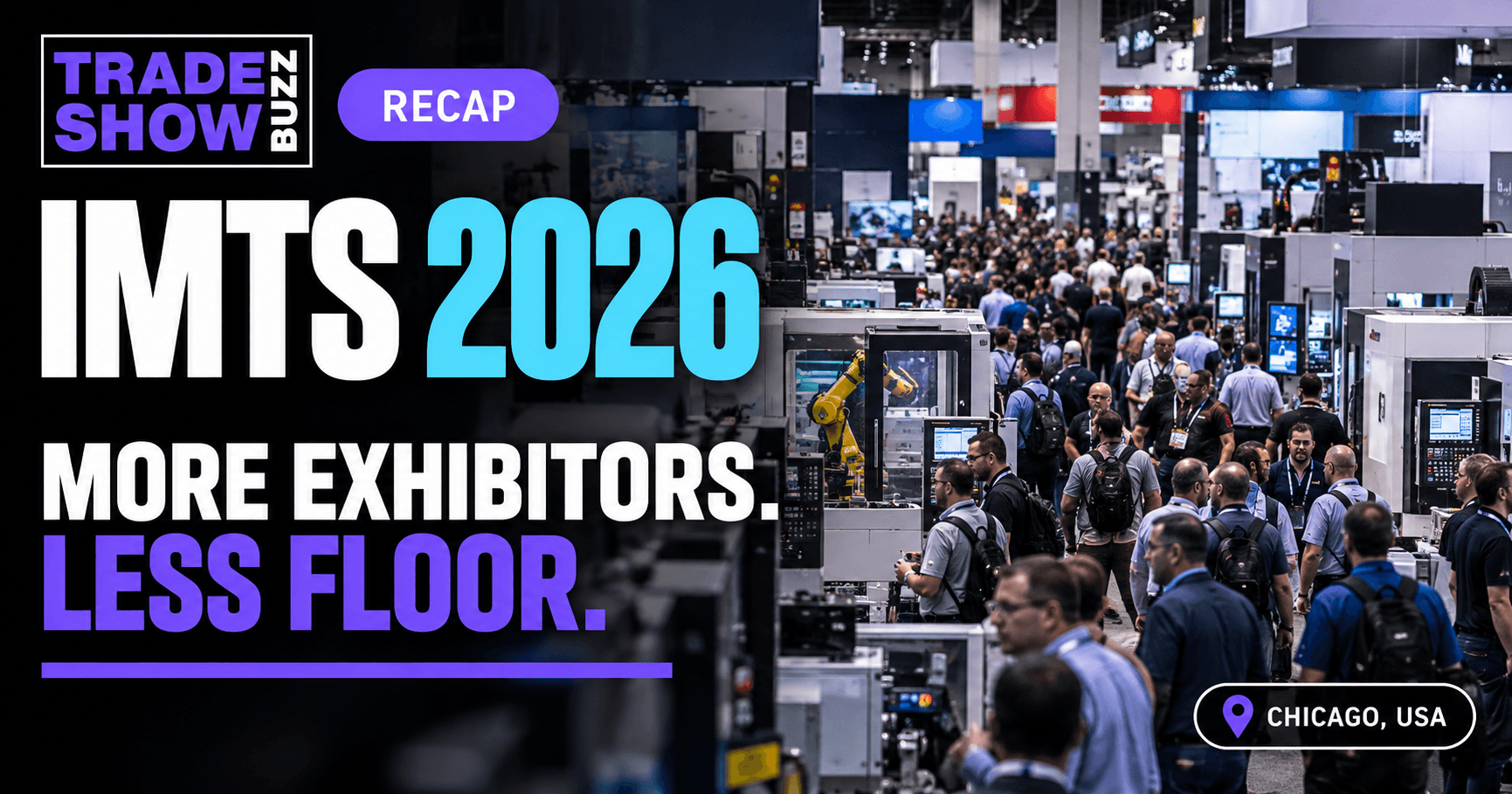
September 14-19, 2026 | McCormick Place, Chicago, Illinois, USA | 1,788 exhibiting companies including 400 first-timers | 91,295 registrants from 114 countries and all 50 states | 1.17 million sq ft | 14,447 students | Record 1.65 floor-density ratio | Next edition: September 11-16, 2028
IMTS 2026 closed on Saturday with a headline number that barely moved and a set of underlying numbers that moved quite a lot. AMT's final count put registration at 91,295, against 89,020 in 2024. On its own that is growth of under three percent, and it is the least interesting thing that happened in Chicago.
The interesting part is underneath. Per AMT's closing report, 1,788 companies exhibited, including 400 first-timers, across 1.17 million square feet. In 2024 the show finished with 1,737 exhibitors across 1,226,523 square feet. So IMTS 2026 put 51 more companies into roughly 57,000 fewer square feet of floor.
That is not a rounding error. Exhibit space per exhibiting company fell about 7%, from roughly 706 square feet in 2024 to roughly 654 in 2026, and it is the single most useful fact to come out of the week for anyone planning a 2028 booth.
Our IMTS 2026 guide, published in August, deliberately refused to quote AMT's shifting pre-show attendance projections and anchored on the 2024 actuals instead. Those actuals are now the right yardstick, so this recap uses them throughout.
The Show Got Wider, Not Bigger
Four hundred first-time exhibitors is 22% of the exhibitor roster. That is a large intake for a biennial show in its eighth decade, and it explains the arithmetic. First-timers take small stands. So do the software and AI companies that made up much of the 2026 intake, because a booth selling an inspection model or a CAM agent does not need the 700 square feet and reinforced flooring that a five-axis machining center does.
Read that way, IMTS 2026 was a show that broadened its supplier base while the physical machine-tool floor held roughly flat or contracted slightly. Both things can be true at once, and for a show whose identity has always been 40 million pounds of metal under one roof, the direction of travel is worth watching.
AMT reached for a different metric to frame it, and introduced a number IMTS has not led with before: the floor-density ratio, measuring visitors relative to exhibitor personnel. It entered the week at 1.42 and finished at 1.65, which AMT called an all-time IMTS record.
It is a genuinely useful number for exhibitors, because it describes how busy your aisle felt rather than how big the building was. It is also, mechanically, a ratio that rises when the floor shrinks and the crowd does not. A smaller floor staffed by fewer exhibitor personnel, visited by roughly the same 91,000 people, produces a higher density reading without a single extra buyer walking through the door. Both readings are fair. Exhibitors should take the busier aisles at face value and still price their 2028 space against the footprint trend, not the density headline.
One housekeeping note on the comparison, because the number 1,609 still circulates for 2024 and turns up in IMTS boilerplate to this day: it is not an exhibitor count. AMT issued a correction in September 2024 clarifying that IMTS 2024 had "1,737 exhibitors, spread across 1,609 booths." Companies, not booths, is the like-for-like comparison against 2026's 1,788, and that is the figure used throughout here.
The Money Was the Real Headline
The strongest signal of the week was not generated on the show floor at all. It landed the day before the doors opened.
AMT's U.S. Manufacturing Technology Orders report put new metalworking machinery orders at $605.8 million in July 2026, bringing the year-to-date total through July to $4.03 billion, up 37.1% on the same period in 2025. The detail that matters more than the percentage: this is only the second time since USMTO began collecting data in 1998 that orders have topped half a billion dollars for five consecutive months.
That is the context every conversation on the floor was happening inside. Manufacturers walked into Chicago in an unusually strong investment cycle, with machinery orders running at a pace the series has recorded only once before in nearly thirty years.
"America has rediscovered a fundamental economic truth: Ultimately, a country creates value by making, mining, or growing something locally," Douglas K. Woods, president of AMT, said at the opening ceremony. "Investment is flowing into U.S. manufacturing at the same time companies are rethinking and regionalizing their supply chains."
Exhibitors described the same weather. "The energy and optimism of IMTS 2026 have been unlike any I've ever been to, and I've been to lots of IMTS shows," said Paul Van Metre, co-founder of ProShop ERP. "There is so much demand for machined parts right now that shops are actively looking for technology, automation, new equipment, and software."
Did the AI Program Deliver?
This was the open question going in, and it deserves a straight answer rather than a summary of the agenda.
IMTS 2026 arrived with three separate AI surfaces: the Industrial AI Arena at the front of the North Building, with 32 AI-focused exhibitors plus Sandia National Laboratories; the one-day Industrial AI Conference on Wednesday 16 September, the show's first; and an IMTS+ Main Stage program in which AWS, Google Cloud, Microsoft and Siemens each argued for their version of the layer underneath everything else. The framing AMT chose for the Main Stage sessions was "moving from pilot to action."
The honest verdict is split.
What did land: named deployments, in quantity, for the first time. Google Cloud's Praveen Rao pointed to work at Ford, ASML, Honeywell, GE Appliances and Toyota. Microsoft's Dayan Rodriguez and Ben Grimes cited Rolls-Royce, TK Elevator and Krones. Siemens brought the most concrete item of the week into the show, though not on the Main Stage: its partner Humanoid's HMND 01 wheeled Alpha robot, built on NVIDIA's physical-AI stack, completed testing on autonomous logistics tasks inside Siemens' own electronics factory in Erlangen, hitting 60 tote moves per hour, over eight hours of uptime and autonomous pick-and-place success above 90%. Those are production numbers rather than demo numbers, which made it one of the more credible physical-AI claims attached to the show. FANUC demonstrated an agent built with Google Cloud that reads handwritten instructions and directs a robot to locate and kit the parts named on the sheet. Limitless Labs said its CAM Agent, which generates native CNC toolpaths from a conversational prompt and integrates with Siemens NX-CAM, is cutting programming time by half at Tier 1 manufacturers.
Two editions ago, the industrial AI pitch at a machine tool show was a capability demo. This one came with customer logos attached.
What did not land: almost none of those logos belong to a job shop. Ford, ASML, Toyota, Rolls-Royce, TK Elevator and Krones are large enterprises with data teams and capital budgets to match. That matters at IMTS, where, by AMT's own description of the audience, tens of thousands of small job shops and contract manufacturers sit alongside the prime contractors and major OEMs. For most of the room, the reference customer on the Main Stage was not a company that looks like theirs.
The clearest shop-scale number in AMT's own industrial-AI coverage is worth examining closely, because of what it turns out to be. Chris Basgall, CEO of Catamount Machine Works, a 10-person shop in Plant City, Florida, reports that High QA's auto-ballooning software cut his document preparation time by about 80%, and calls it "the highest ROI project in the last five years."
That is a real, quantified outcome from a job-shop-scale deployment, and it deserves the attention AMT gave it. But three things about it are instructive. The documented gain comes from auto-ballooning and optical character recognition, reading dimensions off PDF and TIFF drawings and automating document preparation, not from the generative or agentic AI being promoted on the 2026 Main Stage. Basgall found it at IMTS 2022, two editions ago, according to AMT's own case study. And it saves time on paperwork, not on cutting metal.
So the most convincing small-shop result in the show's AI narrative is a document-automation win from two editions ago. That is not a criticism of Catamount, which sounds like exactly the kind of buyer the show exists for. It is a measure of how much distance still separates the Main Stage from the median stand.
The gap has a number attached to it. ABI Research's finding, cited in the run-up to the Main Stage program, is that 85% of manufacturers remain stuck in AI pilots, unable to get from an isolated use case to production. Nothing in Chicago this week retired that statistic.
AMT knew it, too. Previewing the Industrial AI Conference, its headline speaker, Dr. Jay Lee of the University of Maryland, framed adoption around what he calls the 3B problem - broken data, missing background, missing baselines - and put the barrier plainly: "Buying AI alone does not create results, just like buying a gym membership does not make you fit." For a show that had just built an arena, a conference and a Main Stage track around the technology, putting that line in its own program preview was the most honest thing the AI program did.
The most representative shop-floor voice on the subject was careful rather than converted. "We're starting to implement AI, and we spent time with our friends from FANUC to learn how it is advancing AI to enable automation of difficult tasks and make programming more intuitive," said Nicole Wolter, president and CEO of HM Manufacturing, who buys equipment at every IMTS.
"Starting to implement" is where the median attendee actually is. That is progress on 2024, when the honest answer was "still evaluating." It is not procurement.
So: applied AI at IMTS 2026 moved from demo to deployment at the enterprise tier and from curiosity to evaluation at the shop tier. Those are two different distances traveled, and conflating them is how the industry talks itself into another two years of pilots. Our breakdown of what changed in industrial AI booths between 2024 and 2026 and the five deployment patterns actually running in production cover the shop-scale end of that question in more detail.
One data point suggests the connective tissue is working even when the technology is not yet bought. Roger Buccolo, plant manager at Teledyne Oil & Gas in Orlando, came specifically for the Industrial AI Conference, also sat in the Job Shops Workshop, and met Chris Basgall of Catamount Machine Works, a precision shop about an hour from him in Plant City, Florida. They had scheduled their next meeting before leaving Chicago. That is the show working as designed, and it happened at a conference about AI rather than because of one.
The Emerging Technology Center Was the Most Convincing Room
If you wanted evidence that AI, additive and automation compound into something rather than sitting beside each other, the Emerging Technology Center in the North Building (booth #236700) made the argument better than any keynote.
Two exhibits carried it.
Aires Tide, an 11-foot-tall full-scale flight-test vehicle, was AI-designed, printed in Inconel 718 on a Velo3D Sapphire XC, and built in modular sections. Sandia National Laboratories led the project, with Lawrence Livermore, Los Alamos, the Kansas City Nuclear Security Campus and the Department of War's WIRE Directorate involved. The claimed result is roughly seven times faster and fifteen times cheaper than conventional development. A half-scale version was drop-tested from 32,000 feet at the U.S. Army's Dugway Proving Ground on 19 May 2026, which is the part that makes it a program rather than a rendering.
"We went from a concept in October to a test flight in May," said Lonnie Love of Sandia National Laboratories, framing the point as designs tested in weeks or months rather than years.
The drone production cell, developed by the Department of Energy's Manufacturing Demonstration Facility at Oak Ridge National Laboratory, produced, assembled, tested and flew quadcopter airframes live on the floor, with rotors at 3.5, 5 and 10 inches, using Mazak, FANUC, Edgewater Automation, Open Mind's HyperMILL, Kennametal and Schunk equipment connected through MTConnect. The exhibit's argument was high-mix, low-volume production that can surge, which is the actual industrial-base question rather than the marketing one.
ORNL and Mazak also used the ETC to show a convergent metal additive platform built around two Mazak VC-Ez 20X five-axis vertical machining centers with Fronius wire-arc additive integrated into the workflow, aimed at structural repair, rapid tooling and near-net shapes in the same setup.
"The ETC brings concepts like digital twins, automation, and AI into a tangible, credible manufacturing context," said Ryan Kelly, AMT's vice president of technology. On the evidence of this edition, that is the correct claim, and it is a sharper one than the Main Stage managed.
What Was Actually on the Floor
Beyond the AI programming, IMTS 2026 was still a machine tool show, and the metal-cutting debuts were substantial:
- Mitsubishi EDM / MC Machinery used IMTS as the global launch platform for the MG Series wire EDM, successor to the MV Series and Mitsubishi Electric's first flagship wire EDM refresh in 13 years, with AI-driven machining stability, improved wire threading and longer maintenance intervals aimed at unattended running.
- Mazak brought the Integrex i-350S Neo, which adds grinding to turning and milling in a single setup for the first time in the Integrex line.
- Okuma showed the Multus U1000 and U2000 multitasking machines and the LT2000 EX twin-spindle turning center, while Hurco brought the BM500U with a new eight-station pallet changer, Index the MS24-8 eight-spindle multi-spindle, and Haas Automation new multitasking, hybrid and 5-axis machining centers.
- FANUC America (booth #338900) ran demonstrations spanning collaborative and industrial robotics, machine tending, welding, vision and machining, including the CRX-3iA cobot and the Google Cloud handwritten-instruction agent.
- In the AI Arena, Lumafield showed the Triton high-throughput industrial CT scanner for production-speed 3D inspection alongside the Neptune lab scanner and Voyager analysis software, and Overview showed the OV20i and OV80i smart cameras for anomaly detection on defect types the system has not seen before.
- Richtech Robotics ran its DEX humanoid and Titan 440 autonomous mobile robot as a single coordinated system.
The pattern under the product news matters more than any single machine. Embedded AI, not standalone AI, was where most of the floor actually put it: Hexagon inside Esprit Edge CAM, Heidenhain's TNC7 chatbot, Mastercam's new Copilot for adjusting feeds and speeds by voice or text, plus Autodesk, High QA, Keyence, Mazak, Okuma, Siemens, Standard Bots and Universal Robots, all shipping AI capability inside platforms their customers already own.
That is the shorter procurement path, and it is the honest answer to the question the Main Stage kept dodging. A shop that cannot fund a data initiative can still buy a control upgrade. Expect most near-term adoption to arrive that way - as a feature inside the next machine or software renewal, not as an AI project with its own budget line.
The Student Count Slipped
The Smartforce Student Summit moved for 2026, out of the East Building and into Hall C on Level 2 of the North Building. AMT's final count put students at 14,447 of the total registration, against 14,713 recorded for the 2024 Summit.
That is 266 fewer students, a dip of under 2%, in a week when every other conversation was about an industrial base that needs more people. Students and educators attend free with full access to all four halls for all six days, so the constraint is not price. For exhibitors recruiting rather than selling, more than 14,000 students in one place is an unusually concentrated pool of entry-level manufacturing talent, and it is now in the same building as Automation, Gear Generation and the AI Arena rather than across the campus from them.
What It Means for Exhibitors
Three things carry into 2028.
Price your space against a shrinking floor. The show added exhibitors and subtracted square footage. If that trend holds, competition for the large machine-tool footprints in South and North gets tighter, not looser, and the cheap way to be at IMTS increasingly looks like a small stand in a specialist area rather than a scaled-down version of a traditional booth. Note also that IMTS publishes its rates: space ran $37 per square foot standard and $29 for AMT members in 2026, with turnkey 10x10 and 10x20 packages at $7,000 and $13,000.
If you sell AI, bring a customer who looks like the buyer. The enterprise references were plentiful and the job-shop references were not. The vendor that walks into 2028 with three named 20-person machine shops, with payback periods attached, will be selling into a room that has now heard the Fortune 500 version twice and is still waiting for its own.
International attendance is free, and 114 countries used it. IMTS registers international visitors at no charge, and the international share is the part of the audience that grew, from 110 countries in 2024 to 114. For suppliers outside the US weighing Chicago against a European flagship, the entry cost for your own team's scouting trip is zero, which makes the real question hotel and visa lead time rather than badge price. Visitor-visa appointment waits can run for months in some markets, so start that clock in 2027 rather than in the 2028 show year.
Next Edition
IMTS 2028 runs 11-16 September 2028 at McCormick Place in Chicago.
The North American manufacturing calendar does not wait two years, though. Fabtech 2026 runs 21-23 October 2026 in Las Vegas and covers a good share of the same fabricating, welding and forming supply chain. You can browse the rest on our Chicago and Manufacturing pages.
Frequently Asked Questions
When was IMTS 2026 held? IMTS 2026 ran Monday 14 September through Saturday 19 September 2026 at McCormick Place in Chicago, Illinois. It is a biennial show, owned and produced by AMT - The Association For Manufacturing Technology, and has been held in Chicago since 1947 and at McCormick Place since 1972.
How many people attended IMTS 2026? 91,295 people registered, from all 50 US states, Washington, D.C., Puerto Rico and 114 countries, including 14,447 students, according to AMT's final figures. That compares with 89,020 registrants from 110 countries in 2024. Registration stood at 80,697 on the opening morning. AMT also reported a floor-density ratio of 1.65 - equivalent to 165 visitors for every 100 exhibitor personnel - which it described as an all-time IMTS record, up from 1.42 entering the week.
How many exhibitors were at IMTS 2026? 1,788 exhibiting companies took part, including 400 first-time exhibitors, across 1.17 million square feet of exhibit space. The 2024 edition finished with 1,737 exhibitors across 1,226,523 square feet, so IMTS 2026 had more companies in a smaller footprint, with exhibit space per exhibiting company down about 7%.
Was the Industrial AI Arena worth it at IMTS 2026? The Arena was new for 2026, sat at the front of the North Building and held 32 AI-focused exhibitors plus Sandia National Laboratories, paired with the show's first Industrial AI Conference on 16 September and an IMTS+ Main Stage program from AWS, Google Cloud, Microsoft and Siemens. The AI content came with named customer deployments for the first time, but almost all of them were large enterprises such as Ford, ASML, Toyota, Rolls-Royce and Krones rather than the job shops and contract manufacturers who make up most of the audience. Embedded AI inside platforms shops already own, from vendors including Hexagon, Heidenhain, Autodesk and FANUC, was the more immediately purchasable option on the floor.
What was announced at IMTS 2026? Mitsubishi EDM used the show as the global launch platform for the MG Series wire EDM, its first flagship wire EDM refresh in 13 years. Okuma showed the Multus U1000 and U2000 and the LT2000 EX, Mazak the Integrex i-350S Neo with grinding added to turning and milling, Hurco the BM500U with an eight-station pallet changer, and Index the MS24-8 multi-spindle. Oak Ridge National Laboratory and Mazak showed a convergent metal additive platform built on two VC-Ez 20X machining centers with Fronius wire-arc additive. AMT's Emerging Technology Center ran a live drone production cell from Oak Ridge and displayed Aires Tide, an AI-designed, 3D-printed flight-test vehicle developed in about six months.
When is IMTS 2028? IMTS 2028 runs 11-16 September 2028 at McCormick Place in Chicago.