InnoTrans 2026 Recap: Record Numbers on a Floor That Cannot Grow
InnoTrans 2026 set an exhibitor record at its 30th anniversary: 3,190 companies on a fully booked Messe Berlin site. World premieres fell from 226 to 180 and the track display did not grow with it. The figures, the deals signed in Berlin, and the dates that matter for InnoTrans Asia 2027 and InnoTrans 2028.
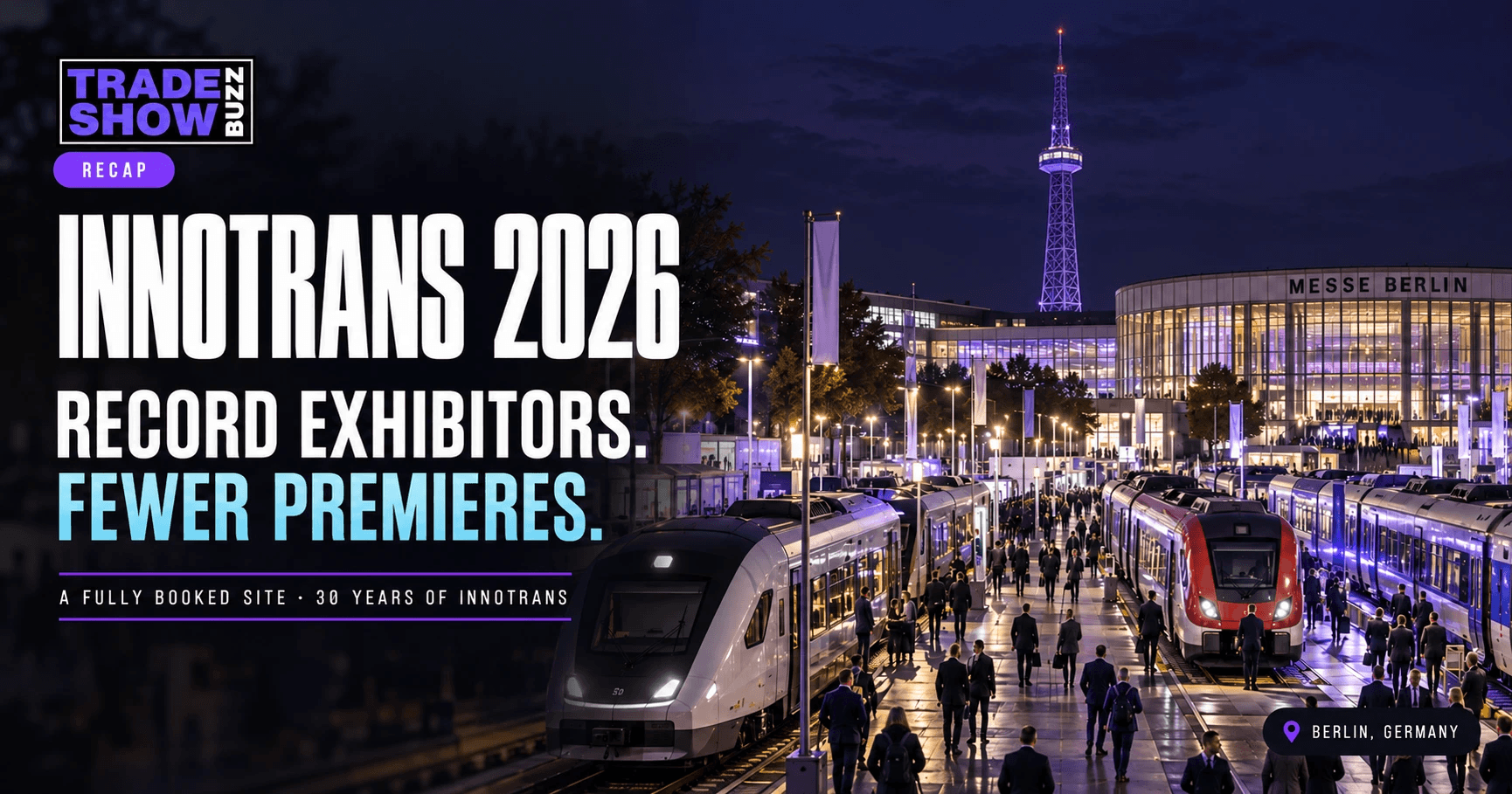
September 22-25, 2026 | Messe Berlin, Germany | 15th edition, 30th anniversary | 3,190 exhibitors from 59 countries, 750 of them first-time exhibitors | 42 halls and the 200,000 sqm grounds fully booked | 180 world premieres, down from 226 | 113 vehicles on the outdoor and track areas | About 175,000 trade visitors from more than 120 countries (preliminary) | Next: InnoTrans Asia, September 7-9, 2027, Singapore | InnoTrans 2028 applications close September 17, 2027
InnoTrans 2026 closed on Friday with three numbers that belong together: 3,190 exhibitors, 180 world premieres and 113 vehicles on the outdoor and track areas. The first is a record for the fair's 30-year history. The second is 46 fewer than two years ago. The third, compared on a like-for-like basis, is probably nine fewer.
That contrast is the story of the anniversary edition. All 42 halls and the outdoor and track area at Messe Berlin were booked, so the fair cannot get physically bigger. In 2026 it took in more exhibitors than ever on that fixed site, while the counts of what was newly launched and physically displayed went down. Messe Berlin's preliminary closing release also reports a visitor record, which the final figures will need to confirm on a like-for-like basis.
If you are coming to this without the background, our InnoTrans 2026 guide covers how the fair works, from the outdoor track display to what a stand costs.
A Record Exhibitor Count on a Fully Booked Site
3,190 companies from 59 countries exhibited, up from 2,946 in 2024 according to the organizer's 2024 facts and figures. The closing release describes that as around 200 more; the difference between the two published figures is 244. Of the 3,190, 750 were first-time exhibitors, against around 600 newcomers in 2024.
First-time exhibitors are not the same as additional exhibitors. Some of the 750 replaced companies that did not return from 2024, and a first-time exhibitor may be a co-exhibitor on another company's stand rather than a stand of its own. The net gain is the 244.
The number of exhibiting countries remained 59.
The constraint is the site. All 42 halls and the full outdoor and track area were booked in both 2024 and 2026, and the 200,000 sqm gross footprint is the whole of Messe Berlin's grounds. There is no spare hall to add. Whatever the extra 244 exhibitors occupied had to come out of the same site as in 2024.
What that means for stand sizes is not yet measurable. In 2024 the fair used 116,459 sqm of net space, 108,083 sqm in the halls and 8,376 sqm on the outdoor tracks. Messe Berlin has not yet published the 2026 net figure. If it is similar, the average exhibitor took less space than in 2024. But shared stands, co-exhibitors, changes in how much of the gross area was let as net space, and turnover among exhibitors could all move that result, so smaller average stands are a possibility rather than a finding until the final figures are out.
Fewer World Premieres, Fewer Vehicles
Two measures of what exhibitors brought moved the other way.
World premieres fell from 226 to 180, a drop of 46, or about 20%. Both figures come from Messe Berlin's closing releases. A world premiere is a label the exhibitor chooses rather than a standard measure, so one edition's fall should not be read as a collapse in innovation. It does show that exhibitors reported fewer world premieres than in 2024.
The vehicle count needs more care. The official 2024 figure is 133 vehicles, and the organizer's facts and figures state that 11 of those were buses, which leaves 122 rail vehicles. The 2026 closing release counts 113 vehicles from 17 countries "on the outdoor and track areas" and does not say whether buses are included. Railcolor News's walk-through of the 2026 track described 113 rail vehicles, which suggests the 2026 figure excludes buses. On that basis, the like-for-like comparison is 122 rail vehicles in 2024 against 113 in 2026, a fall of nine. Messe Berlin has not confirmed the basis, and the final figures should settle it.
Nine fewer vehicles on 3,500 metres of track is a modest change, and the count says nothing about which companies were behind it. It is still notable in the edition that set the exhibitor record: the most expensive and most planned form of exhibiting at InnoTrans did not grow along with the headcount.
The Visitor Record Awaits Final Figures
The closing release reports "approximately 175,000 trade visitors from more than 120 countries," an increase of "more than 5,000 trade visitors" on 2024.
InnoTrans publishes two attendance figures for each edition. For 2024, the final figures were 169,214 total visitors and 159,230 trade visitors. The 2026 figure of 175,000 is preliminary and rounded, and "more than 5,000" is consistent with a comparison against either 2024 number: it is 5,786 above the total and about 15,770 above the trade visitor count. The release does not say which 2024 figure it used.
So the precise like-for-like increase is not known yet. The 2024 edition followed the same pattern: its closing release announced around 170,000 visitors, and the split into total and trade visitors came later. When Messe Berlin publishes the final 2026 figures, the comparison can be made on the same basis.
What is not in doubt is that attendance rose, at a fair that has had no public days since 2018. On the reach measure, 2024 drew visitors from 128 countries; the 2026 release says more than 120.
AI Took Over the Conversation
The closing release was explicit about what dominated the four days. InnoTrans Director Kerstin Schulz said that with InnoTrans 2026, artificial intelligence had arrived across the whole sector, and the release named AI, digitalization, automation, cybersecurity and new drive technologies as the lead themes.
The floor supported that. The AI Mobility Lab in hall 7.1a, back for its second edition, sold out with 47 exhibitors working in AI, automation, cybersecurity and robotics, 28 of them at InnoTrans for the first time. Exhibitors there included SNCF Réseau, Boston Consulting Group, Fortinet, IAV, Google Cloud and the CRRC Academy. The fair also ran its first hackathon, "AI on Track," from September 23 to 25.
The launches followed the same line. Siemens Mobility's Vectron X, a locomotive platform it describes as software-defined, with an app store for digital functions such as remote start and predictive maintenance, made its InnoTrans debut after its unveiling in Munich in June. Alstom presented "Talk to my train," an AI assistant for maintenance teams. Knorr-Bremse showed its LEADER Flow driver assistance system, and smaller exhibitors such as OTIV and Scout Robotics brought autonomous operation and inspection systems.
New drive technology was the other theme on the track. CRRC showed a hydrogen fuel cell hybrid locomotive, Stadler a hydrogen train for narrow gauge, and battery trains came from Škoda, Siemens (a Mireo Plus B for S-Bahn Mitteldeutschland) and CAF.
The Deals Signed in Berlin
InnoTrans is a place where contracts get signed as well as announced, and 2026 had several large ones.
Siemens Mobility and VinSpeed, Vietnam. On the opening day, Siemens and VinSpeed signed a turnkey contract worth up to €1 billion for two high-speed lines: Hanoi to Quang Ninh (121 km) and Ben Thanh to Can Gio (54 km). Siemens will supply 10 Velaro Novo trainsets for 350 km/h running, plus signaling, electrification and communications, with ETCS Level 2 and automatic train operation.
Railpool and RDC, Vectron X. Vectron X also picked up orders at the show. Leasing company Railpool ordered 100 locomotives, 80 firm (30 Vectron X AC and 50 Vectron X Dual Mode) with an option on 20 more, with first deliveries planned for 2027. RDC Deutschland ordered two dual-mode units, worth about €10 million, for its Sylt car-shuttle service.
Saudi Arabia Railways. SAR used the fair to sign a package of contracts: 10 passenger trains from Stadler, financed through the Swiss export credit agency SERV with KfW IPEX-Bank, Commerzbank and UBS Switzerland; 33 freight locomotives from Progress Rail; 782 freight wagons from Greenbrier; a maintenance and technical support agreement with Alstom; and two memoranda of understanding on localizing brake component manufacturing, involving Knorr-Bremse.
None of these deals measures how the fair performed, and the organizer publishes no figure for business done on site. But they show why the largest suppliers keep coming back despite the cost: a large share of the sector's buyers are in the same place in the same week.
The Next Cycle Starts Now
Three dates matter more to exhibitors than anything in the closing release.
InnoTrans 2028 stand applications are already open. The organizer's stand application page gives January 10, 2027 as the early bird registration date and September 17, 2027 as the application deadline, a full year before the fair. That matches the pattern of the last two editions, both of which were booked out about a year ahead.
InnoTrans Asia comes first. The Singapore edition, announced by Messe Berlin in June 2025, runs September 7-9, 2027, at Singapore Expo, in the year between Berlin editions. Its exhibitor packages are already available, from 9 sqm shell scheme stands to raw space from 18 sqm, and the organizer's exhibitor FAQ says its early bird rates end October 31, 2026. Companies considering both events should assess Singapore first, then Berlin 2028, whose early bird registration runs through January 10, 2027.
What It Means for Exhibitors
Put January 10, 2027 in the calendar. The fair has been booked out a year ahead in consecutive editions, the site cannot grow, and the exhibitor count rose by 244. Registering by the early bird date is the concrete step; leaving the application until close to the September 2027 deadline is how you end up in shared space or on a waiting list.
Plan for a crowded floor. More exhibitors on the same site means more competition for visitor attention in every hall, whatever the final net-space figures show about stand sizes. Pre-booked meetings and a clear reason to visit will do more work than they did in 2024.
Treat the outdoor display as a separate decision. The track display did not grow with the exhibitor count. If you are deciding whether to show rolling stock in 2028, the question is what a track slot achieves that a stand, a model and a meeting program cannot.
Use final figures for any ROI case. Until Messe Berlin publishes the final 2026 visitor split, quote about 175,000 trade visitors as a preliminary figure and hold off on a precise year-on-year comparison.
Assess Singapore by October 31, 2026. If Asia-Pacific is a target market, InnoTrans Asia's early bird rates end on October 31, 2026, more than two months before the Berlin 2028 early bird date. Decide on Singapore first, then Berlin.
By the Numbers
- 3,190 exhibitors from 59 countries, up from 2,946 from 59 countries in 2024
- 750 first-time exhibitors, against around 600 in 2024
- 42 halls and the full 200,000 sqm gross footprint booked
- 180 world premieres, down from 226
- 113 vehicles from 17 countries on the outdoor and track areas; 2024 had 133 including 11 buses, or 122 rail vehicles
- About 175,000 trade visitors from more than 120 countries, preliminary, reported as more than 5,000 up on 2024
- 47 exhibitors in the AI Mobility Lab, 28 of them new to InnoTrans
- More than 90% satisfaction in the organizer's survey of participants
- Up to €1 billion: the Siemens-VinSpeed high-speed contract for Vietnam, signed on the opening day
- 100 Vectron X locomotives ordered by Railpool, 80 firm
- October 31, 2026: InnoTrans Asia early bird rates end
- January 10, 2027: early bird registration for InnoTrans 2028; September 17, 2027: application deadline
When Is the Next InnoTrans?
The next event under the InnoTrans name is InnoTrans Asia, September 7-9, 2027, at Singapore Expo, the first edition held outside Berlin.
The Berlin fair is biennial, so the next Berlin edition is InnoTrans 2028. Stand applications are open now, with an early bird date of January 10, 2027 and a deadline of September 17, 2027. The organizer's pages we checked do not yet show the 2028 event dates. Some public listings give September 19-22, 2028; confirm on innotrans.de before booking travel.
Frequently Asked Questions
When was InnoTrans 2026 held? InnoTrans 2026 ran September 22-25, 2026, at Messe Berlin in Germany. It was the 15th edition of the fair and marked its 30th anniversary. It was open to trade visitors only, 9:00 to 18:00 from Tuesday to Thursday and 9:00 to 16:00 on Friday.
How many people attended InnoTrans 2026? Messe Berlin's preliminary closing release reports approximately 175,000 trade visitors from more than 120 countries, more than 5,000 above 2024. The 2024 final figures were 169,214 total visitors and 159,230 trade visitors, and the release does not say which it compared against, so the precise increase will be clear when the final 2026 figures are published.
How many exhibitors were at InnoTrans 2026? 3,190 exhibitors from 59 countries, a record, up from 2,946 in 2024. 750 of them were exhibiting at InnoTrans for the first time. All 42 halls and the full outdoor and track area were booked.
Was InnoTrans 2026 bigger than 2024? In exhibitors, yes, and attendance also rose. In site area, no, because the fair already fills all of Messe Berlin's grounds. Some measures of the display went down: 180 world premieres against 226 in 2024, and, on the apparent rail-only basis, 113 vehicles on the outdoor and track areas against 122 rail vehicles in 2024 (133 including buses). Messe Berlin has not confirmed whether the 2026 count includes buses.
What were the main themes at InnoTrans 2026? Artificial intelligence dominated, according to the organizer, alongside digitalization, automation, cybersecurity and new drive technologies. The AI Mobility Lab in hall 7.1a had 47 exhibitors. Siemens Mobility's software-defined Vectron X locomotive made its InnoTrans debut, and Alstom presented its "Talk to my train" AI assistant for maintenance teams. Hydrogen and battery trains from CRRC, Stadler, Škoda, Siemens and CAF were on the track.
What deals were signed at InnoTrans 2026? Siemens Mobility and VinSpeed signed a contract worth up to €1 billion for two high-speed lines in Vietnam, with 10 Velaro Novo trainsets. Railpool ordered 100 Vectron X locomotives, 80 of them firm. Saudi Arabia Railways signed for 10 Stadler passenger trains, 33 Progress Rail locomotives and 782 Greenbrier freight wagons, plus maintenance and localization agreements.
Can the public attend InnoTrans? No. InnoTrans has been a trade-only fair since the last public weekend in 2018, and 2026 had no public days.
How do I exhibit at InnoTrans 2028? Stand applications for InnoTrans 2028 are open on innotrans.de. The early bird registration date is January 10, 2027 and the application deadline is September 17, 2027. The last two editions were booked out about a year ahead.
When is the next InnoTrans? InnoTrans Asia debuts September 7-9, 2027, at Singapore Expo. The next Berlin edition is InnoTrans 2028; the organizer's pages did not yet show event dates when we checked, and some public listings give September 19-22, 2028.