
WindEnergy Hamburg 2026 Recap: Storage Gets a Hall as Germany's Offshore Reset Looms
WindEnergy Hamburg 2026 reported more than 1,600 exhibitors and over 40,000 attendees, the same thresholds as 2024. What changed was inside the fair: storage got a hall of its own, new turbines matched the sizes the industry now expects, and Germany's offshore market arrived with no auction this year and a reform bill developers criticized.
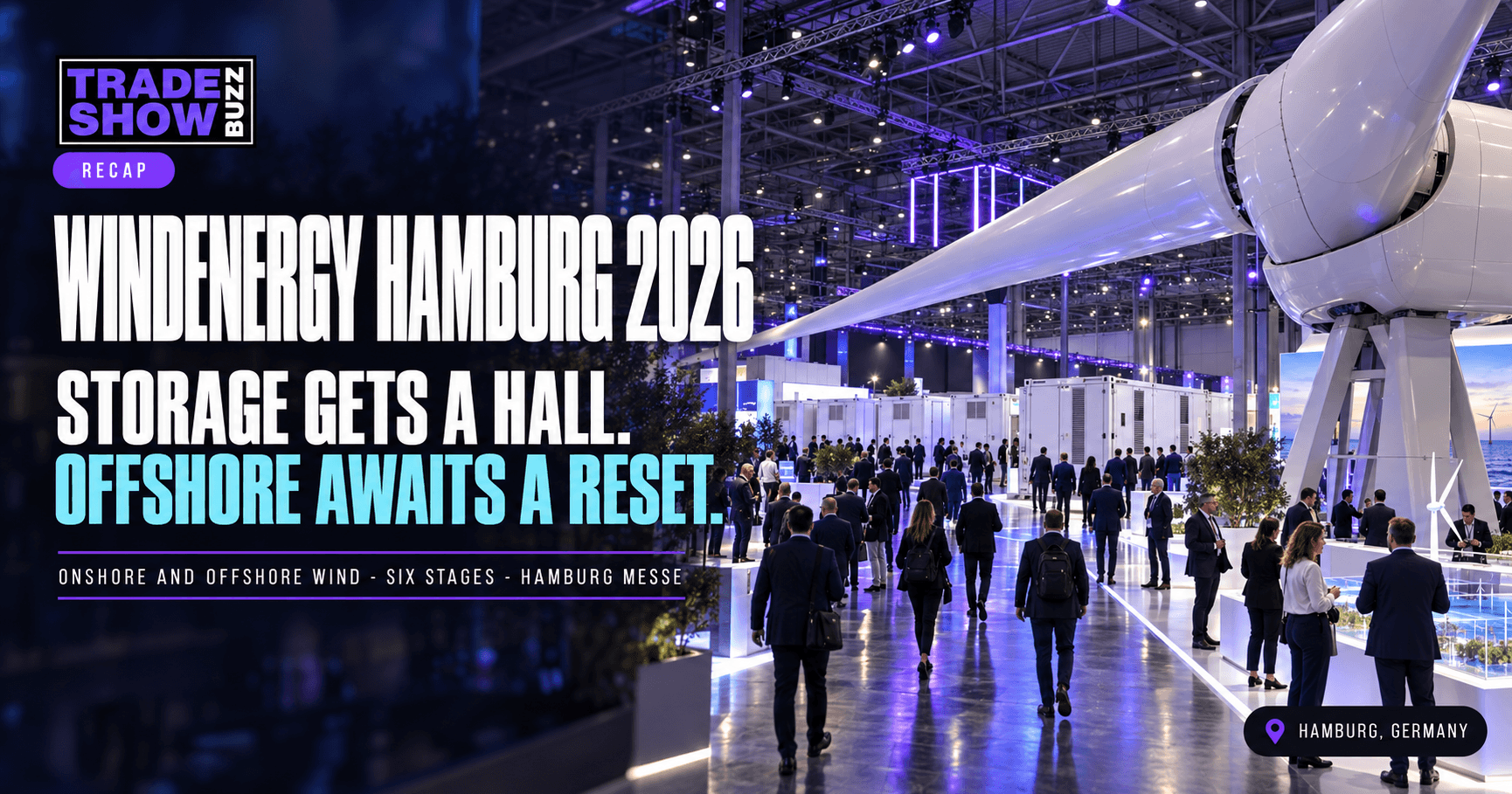
September 22-25, 2026 | Hamburg Messe und Congress, Germany | 1,600+ exhibitors from around 40 countries | 40,000+ attendees from more than 100 nations (preliminary) | Around 30 national pavilions, Czech Republic and Greece for the first time | 300+ speakers on six open stages | Energy storage in a hall of its own for the first time | Next: WindEnergy Asia-Pacific, Singapore, May 25-27, 2027; WindEnergy Hamburg, September 26-29, 2028
WindEnergy Hamburg 2026 closed on Friday with headline figures that read almost exactly like 2024's. More than 1,600 companies exhibited, the same threshold the organizer reported two years ago. More than 40,000 attendees came from over 100 nations, against "over 43,000 participants from around 100 nations" in the 2024 closing release.
Neither comparison supports a growth or a decline story. Both editions' figures are preliminary estimates taken at noon on the final day, and both are rounded minimums: two counts above 1,600 can still differ in either direction. The 2026 closing release also says that no visitor satisfaction results were available "at the time of publication," "due to a change in the modalities of the final qualified visitor survey."
The more useful story is what changed inside the fair: storage got a hall of its own, the product launches matched the turbine sizes the industry now expects, and Germany's offshore wind market arrived with no auction this year and a reform bill that developers criticized at the fair.
Same Headline Thresholds, a Bigger Footprint on Paper
Before the show, Hamburg Messe und Congress was pointing to growth. In March it said the fair would cover more than 80,000 square meters for the first time, that exhibitor registrations were running about 5% ahead of the same point before the 2024 edition, and that a record 30 national pavilions had signed up. By August, a branded preview on offshoreWIND.biz advertised 83,000+ square meters across 11 halls.
The closing release does not return to any of that. It gives no exhibition space figure, no hall count, no international share and no exact exhibitor count, only "more than 1,600 companies from around 40 countries." Around 30 national pavilions were set up, with the Czech Republic and Greece taking part for the first time.
The organizer's German-language final report repeats the same rounded figures, so whether the pre-show 5% registration lead held is not knowable from what has been published.
The conference program did grow by one measure. 2024 ran on five open stages; 2026 ran on six, still with more than 300 speakers. One of the six was the new Energy Storage Stage.
Storage Got Its Own Hall
The one structural change the organizer called out was the Energy Storage Area, which the closing release describes as "the inclusion of energy storage as a featured topic with an exhibition hall of its own." It occupied hall A2, roughly 3,600 square meters, with its own Energy Storage Stage.
The pitch to wind companies is economic rather than technical. The release frames storage and smart system integration as "game changers" because they improve the economics of wind farms. The industry association for storage made the same point from the other side. Gerrit Lühring of BVES, the German Energy Storage Systems Association, said the conversations on the floor "highlighted the growing importance of co-location," meaning wind farms with integrated storage sharing a grid connection, "as they significantly improve the economic viability of the facilities." He said the panels on bankability and financing of wind-storage projects played to fully occupied rows.
Exhibitors in the hall were positive, according to the organizer's round-up of exhibitor quotes. Eduard Meiloiu, Vice President Renewables at the engineering firm ENEVO Group, which works as an EPC partner on wind and hybrid projects and sells SCADA, automation and cybersecurity services, said the area was the "ideal platform" for the company and that it "explored numerous opportunities for collaboration, both here in Germany and across Europe." At an advertised 3,600 square meters, though, the area was about 4% of the advertised 83,000, a first step rather than a second fair. The organizer has not yet confirmed its size or hall for 2028 on the Energy Storage Area page.
Grid capacity was the thread connecting storage to the rest of the program. The closing release lists grid expansion as a core topic, noting that "many markets are still lagging behind in terms of grid intertie options and grid capacity," and ports, logistics and offshore supply chains as prerequisites for turbines "that keep growing in size."
The Launches Settled on Sizes the Industry Expects
Two new onshore turbines were presented at the fair. Nordex's N193/7.X extends its Delta4000 platform with a 193-meter rotor on 95-meter single-piece blades, rated up to 7.3 MW, with a 6.6 MW variant for the German market. Nordex claims up to 14% more energy yield than the N175/6.X at typical low- to medium-wind sites. Series production is due from 2029. CEO José Luis Blanco said the fair "was an opportunity to present the new N193/7.X as the next development step in our successful Delta4000 platform."
On the final day, Envision launched the EN175/8.0, an 8 MW onshore turbine with a 175-meter rotor for medium-wind sites, built on its Model T platform. Envision claims a 2-12% gain in energy yield depending on site conditions and says the platform has more than 4,000 units ordered and around 1,500 installed. Those are the company's own figures.
Both ratings sit close to what the industry told the organizer it expects. In the 17th WindEnergy trend:index, published in June, respondents put the average new onshore turbine in 2030 at around 8.3 MW and the average offshore turbine at around 19.1 MW, "slightly less than in recent surveys." The survey's own reading was that turbine size expectations "are now levelling off" as the industry focuses on "unit sizes that are economically feasible and technically proven." The launches in Hamburg were consistent with that: platform extensions and yield gains rather than a race to a headline megawatt figure.
Much of the product news sat in the drivetrain. ZF Wind Power used the fair to launch its SHIFT Modular Powertrain Platform, which combines modular gearbox and main bearing configurations with an integrated generator design and can be configured for different turbine designs and load conditions, onshore and offshore. CEO Dr. Jochen Witzig called the fair "the perfect moment to introduce" it. Flender presented Winergy Genera, a compact generator built without permanent magnets and so without rare earths, which the closing release offered as its example of supply-chain resilience. Flender Group CEO Andreas Evertz said that "every kilogramme of material saved, and every extra percentage point of efficiency gained make wind energy more competitive."
Envision was not the only Chinese manufacturer using Hamburg to talk to international buyers. SANY Renewable Energy used a press release from the fair to report more than 300% growth in overseas revenue in the first half of 2026 and signed international orders approaching 5 GW, across all overseas markets rather than Europe alone. Those are the company's own figures.
Lifecycle was on at least one supplier's radar. Peter Küpper, CSO of thyssenkrupp's slewing-bearing business Rothe Erde, said "the topic of lifecycle is increasingly coming into focus," which he called "good news for us as a component supplier."
The Mood Behind the Stands
The quotes the organizer collected from exhibitors were uniformly upbeat. Its own survey of the industry was not. The two measure different things at different times: the quotes describe how exhibitors rated the fair in September, while the survey asked about market conditions in the spring. Both can be true at once, and the survey is the better guide to the business behind the stands.
The trend:index drew 718 respondents between mid-March and early May 2026, 399 of whom completed all or nearly all of the questionnaire. Its headline was "muted expectations." Germany and Europe had "lost much of their momentum" since the end of 2025, with several indicators "barely clearing the neutral index value." Asia still scored best, but "even here, the mood has clearly declined." North America was "the obvious negative outlier," below neutral on nearly all segments, with changed energy and environmental policies named as the reason. The obstacles respondents ranked highest were permitting, grid development, investment security and supply-chain resilience.
The closing release acknowledged the same list in more positive language: the industry can continue "along its growth trajectory" despite "high financing costs, slimming margins, supply chain issues and lengthy permitting processes."
Germany's two segments are telling different stories. Onshore is moving: 2,363 MW was commissioned in the first half of 2026, up 7% on a year earlier. Offshore auctions have stalled. The August 2025 auction for sites N-10.1 and N-10.2, 2.5 GW in total, received no bids at all. In January the government pushed its 2026 offshore tenders back to 2027, so there is no German offshore auction this year.
The replacement arrived three weeks before the fair. On September 2 the federal cabinet approved an amendment to the Offshore Wind Act, now with the Bundestag and planned to take effect on January 1, 2027. As approved by the cabinet, the bill would start tenders with dynamic bidding and hold a contract-for-difference auction only if no project is awarded, and would set a standard operating period of 35 years. The Offshore Wind Energy Foundation also pointed to around 16 GW of already-awarded projects still awaiting final investment decisions, which the bill does not address. The offshore industry association BWO has argued since the draft that the CfD should be part of the tender design rather than a fallback.
The criticism carried into the fair: according to Windpower Monthly's report from the conference, developers there called the two-stage plans "useless" and "dangerous." Tobias Keitel, CTO of RWE Offshore Wind, made the general case in the organizer's round-up of exhibitor quotes: Europe can make offshore wind "a cornerstone" of its energy supply "with a stable regulatory framework that enables investment."
For the offshore supply chain on the floor, from cable makers to crane suppliers to installation contractors, that is the practical issue. New German sites wait on a law that is not yet final and an auction design that BWO and developers have criticized, while already-awarded projects face their own investment decisions.
What It Means for Exhibitors
Don't build a 2028 budget case on audience growth. The 2026 evidence is a preliminary count of "over 40,000 from more than 100 nations," with no satisfaction results at publication. Treat it as a historical reference point, not a forecast of 2028 turnout.
Storage and hybrid suppliers now have a route in. The Energy Storage Area was advertised at about 3,600 square meters in 2026, and its 2028 size and hall are not yet confirmed. It is small, but it puts battery and system-integration companies in front of wind developers who are, on BVES's account, actively asking about co-location and how to finance it.
If you sell into German offshore, track the Bundestag. The amended Offshore Wind Act is planned to take effect on January 1, 2027, and the first tenders under it follow in 2027. How the CfD question is settled will shape how quickly new German sites come back to market. Suppliers focused on other offshore markets are less exposed to this timetable.
Lead with yield, not size. The 2026 launches were platform extensions, drivetrains and material savings, each pitched on yield or cost, and the industry's own survey says turbine size expectations have leveled off. Exhibitors selling components and services may find more traction in yield per site and lifetime value than in megawatt headlines.
Apply for 2028 now, and decide on Singapore alongside it. Applications for WindEnergy Hamburg 2028 are already open; stand planning begins in April 2027 and proposed stand allocations go out from August 2027. If Asia-Pacific is a target, WindEnergy Asia-Pacific, powered by RECHARGE, runs in Singapore on May 25-27, 2027, in the region the trend:index still rates best; the organizer says a number of associations and exhibitors have already committed.
By the Numbers
- 1,600+ exhibitors from around 40 countries, the same "more than 1,600" threshold as 2024
- 40,000+ attendees from more than 100 nations; 2024 reported "over 43,000 participants" from around 100 nations. All figures for both editions are preliminary, counted at noon on the final day
- No visitor satisfaction results available at publication, due to a change in the survey method
- Around 30 national pavilions, with the Czech Republic and Greece participating for the first time
- 300+ speakers on six open stages, up from five stages in 2024
- 83,000+ sqm across 11 halls advertised before the show; no post-show space figure published
- ~3,600 sqm advertised: the new Energy Storage Area in hall A2
- 7.3 MW, 193 m rotor: Nordex's N193/7.X, series production from 2029
- 8 MW, 175 m rotor: Envision's EN175/8.0, launched on the final day
- 8.3 MW onshore, 19.1 MW offshore: expected average new turbine size in 2030, per the June trend:index (718 respondents)
- 0 bids in Germany's August 2025 offshore auction for 2.5 GW; no German offshore auction in 2026
- January 1, 2027: planned start of the amended German Offshore Wind Act
When Is the Next WindEnergy Hamburg?
WindEnergy Hamburg is biennial. The next Hamburg edition runs September 26-29, 2028, at Hamburg Messe und Congress. Exhibitor applications for 2028 are open on the organizer's stand booking page, with stand planning from April 2027 and proposed allocations from August 2027.
Before that, the same organizer runs WindEnergy Asia-Pacific, powered by RECHARGE, in Singapore on May 25-27, 2027.
See the WindEnergy Hamburg show page for dates and venue details, and our SMM 2026 recap for the maritime fair Hamburg Messe und Congress ran three weeks earlier.
Frequently Asked Questions
When was WindEnergy Hamburg 2026? WindEnergy Hamburg 2026 ran September 22-25, 2026, at Hamburg Messe und Congress in Hamburg, Germany. It was open 10:00 to 18:00 Tuesday to Thursday and 10:00 to 16:00 on Friday.
How many people attended WindEnergy Hamburg 2026? The organizer reports more than 40,000 attendees from more than 100 nations. The figure is a preliminary estimate based on statistics from noon on the final day. The 2024 figure, on the same basis, was over 43,000 participants from around 100 nations; both are rounded minimums, so they do not establish a change in attendance.
How many exhibitors were at WindEnergy Hamburg 2026? More than 1,600 companies from around 40 countries, with around 30 national pavilions. The Czech Republic and Greece had national pavilions for the first time. The 2024 edition also reported more than 1,600.
What was new at WindEnergy Hamburg 2026? Energy storage had an exhibition hall of its own for the first time: the Energy Storage Area in hall A2, about 3,600 square meters, with a dedicated Energy Storage Stage. The conference program grew from five to six open stages, and Recruiting Days for trainees and students were held again.
What turbines were launched at WindEnergy Hamburg 2026? Two onshore turbines: Nordex presented the N193/7.X, with a 193-meter rotor and a rating of up to 7.3 MW, due in series production from 2029, and Envision launched the EN175/8.0, an 8 MW turbine with a 175-meter rotor. In drivetrains, ZF Wind Power launched its SHIFT Modular Powertrain Platform and Flender presented Winergy Genera, a generator built without permanent magnets.
What were the main themes at WindEnergy Hamburg 2026? According to the organizer: grid expansion, ports and offshore logistics, supply-chain resilience and energy sovereignty, storage and system integration, digitalization, artificial intelligence and recruiting talent. German offshore wind policy was also debated, following the cabinet's approval of an amended Offshore Wind Act on September 2, 2026.
When is the next WindEnergy Hamburg? The next Hamburg edition is September 26-29, 2028. Before that, the organizer runs WindEnergy Asia-Pacific, powered by RECHARGE, in Singapore on May 25-27, 2027.