
Expo Real 2026 Recap: 1,777 Exhibitors, a Cautious Market and an Infrastructure Debut
Expo Real 2026 closed in Munich on October 7 with 1,777 exhibitors from 37 countries and more than 42,000 participants, both slightly up on 2025. The bigger change was the scope: investable infrastructure got its own area, InfrastructureNow, in a market Messe München describes as cautious but recovering.
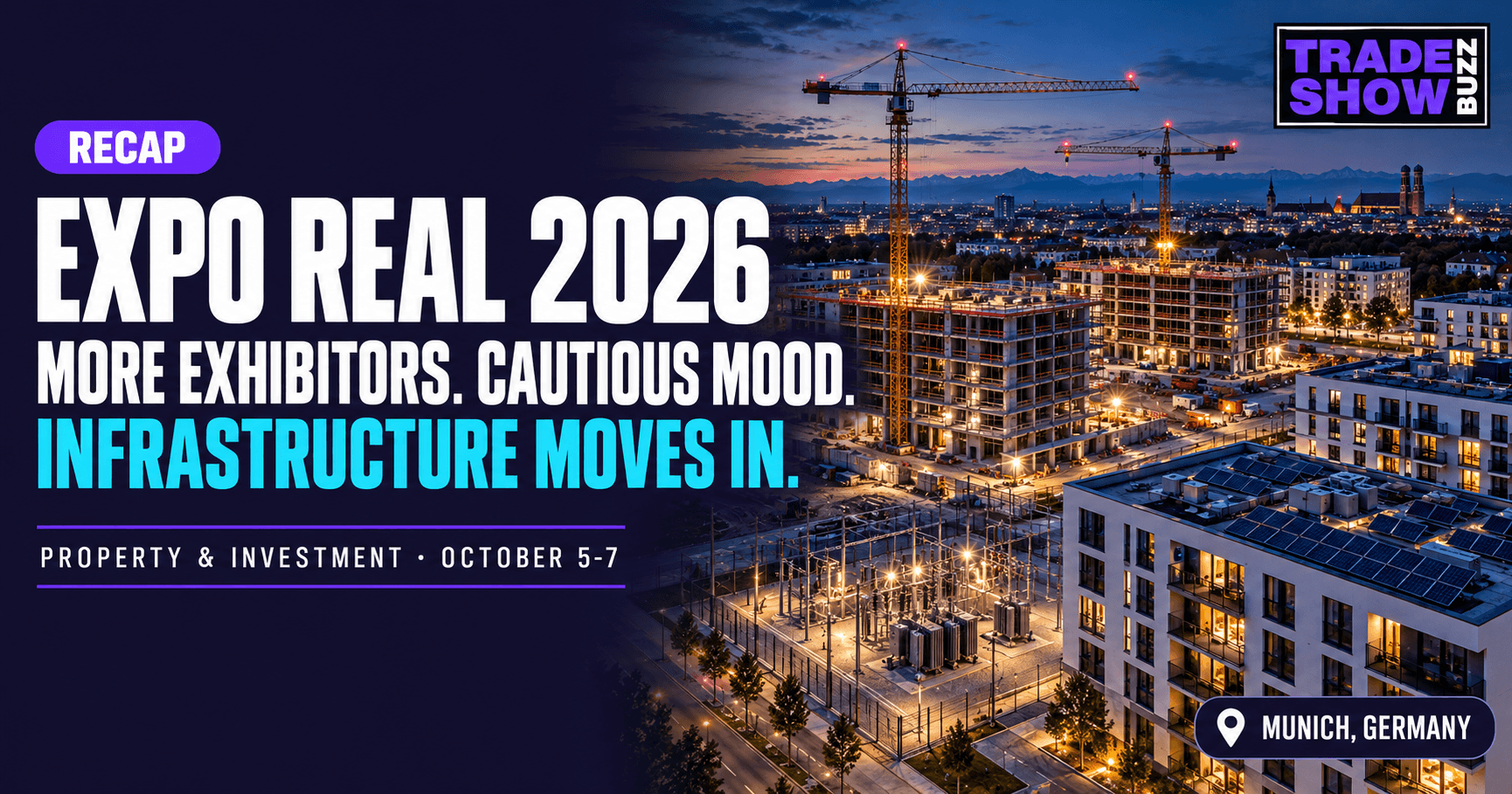
October 5-7, 2026 | Messe München, Munich, Germany | 1,777 exhibitors from 37 countries (2025: 1,742 from 34) | More than 42,000 participants from 74 countries (2025: around 42,000 from 70) | 76,000 m² across seven halls | First edition with a dedicated investable infrastructure area, InfrastructureNow | Next: October 4-6, 2027, Munich
Expo Real 2026 closed at Messe München on Wednesday, October 7, with 1,777 exhibitors from 37 countries and more than 42,000 participants from 74 countries, according to the organizer's final report. A year earlier, Messe München reported 1,742 exhibitors from 34 countries and around 42,000 participants from 70 countries. The show used the same footprint as in 2025: 76,000 square meters in seven halls.
On exhibitors, that is a measurable gain of 35 companies, about 2%, and three more exhibitor countries. On participants, Messe München says only that attendance was "slightly above the previous year's level." Both years are given as rounded figures, so the size of the increase cannot be calculated. The organizer's own headline for the edition was "Modest growth meets harsh reality."
The more useful story for exhibitors is what changed inside the halls. For the first time, Expo Real gave investable infrastructure its own area, covering energy, digital and social infrastructure and defense real estate. Housing kept its dedicated forum, and the organizer's pre-show survey of exhibitors and visitors found the industry more cautious than a year ago, even as consultancies CBRE and JLL reported German transaction volumes rising.
The Numbers Against Recent Editions
The 2026 and 2025 figures below are from the organizer's 2026 final report. The 2024 figures are from Messe München's 2024 final report as republished by the German property portal Konii, a secondary source; we could not find the 2024 release on the organizer's current site.
| Edition | Exhibitors | Exhibitor countries | Participants | Participant countries |
|---|---|---|---|---|
| 2024 | 1,778 | 34 | more than 40,000 | 75 |
| 2025 | 1,742 | 34 | around 42,000 | 70 |
| 2026 | 1,777 | 37 | more than 42,000 | 74 |
Read this way, 2026 reversed the 2025 dip in exhibitors and brought the count back to almost exactly the 2024 level, with three more exhibitor countries than either earlier year. Participant numbers, all given as rounded figures, have stayed in the low 40,000s for three editions.
One caution on the source pages: Messe München's good reasons to exhibit page gives 2025 participants as coming from 70 countries in its introduction and 75 in its figures panel. We use 70, the figure in the 2026 final report's comparison.
InfrastructureNow: Infrastructure Gets Its Own Area
The main addition was InfrastructureNow, which Messe München announced in September as a new topic area with its own forum, a separate conference program and an accompanying special show. It covered four segments: energy infrastructure, digital infrastructure such as data centers, social infrastructure such as facilities for education, health and administration, and defense. On defense, Exhibition Director Claudia Boymanns said before the show that the focus was "not on military equipment, but on the real estate and facilities behind it."
Messe München has not published visitor numbers or an exhibitor count for the area. Its final report says only that the expansion "met with an overwhelmingly positive response from exhibitors and visitors." The final report quotes three participants on it:
- Alexander Heinzmann, CEO of BPD Immobilienentwicklung, said real estate and infrastructure have to be considered together, and that in larger urban and neighborhood developments, housing, mobility, energy supply, open space and social infrastructure "must be planned together from the outset."
- Michael Henn, Global Head of Infrastructure Investments at Commerz Real, said infrastructure "is evolving from a standalone asset class into an integral part of modern real estate asset strategies."
- Oguz Kusdil, Managing Director and Founder of commonreal, which exhibited for the first time, described the show as a way to position the company in social infrastructure and meet investors, banks, operators and project partners.
The organizer's pre-show survey explains why Messe München made the move. Of the 430 exhibitors and visitors surveyed, 71% agreed that infrastructure gets more consideration in real estate projects than five years ago, and 70% said growing infrastructure investment needs will increasingly have to be met by private and institutional investors.
Housing, Politics and the Federal Minister
Housing was the second main theme. The "Flexible Housing - Opportunities Next Door" forum, introduced in 2025, returned with a special exhibition on affordable and resource-efficient housing. According to the final report, discussion centered on how Germany can build more affordable housing despite high construction and financing costs and long planning and approval processes, through new construction, adding floors, conversions, and serial and modular building.
Federal Minister for Housing, Urban Development and Building Verena Hubertz visited the show and took part in a scheduled panel on the future of new construction in Germany on October 5. In the final report she called Expo Real "a marketplace where all the various trades come together," adding that "there are no easy solutions." Prof. Alexander von Erdély, spokesperson for the Executive Board of Germany's Federal Agency for Real Estate Affairs, said serial and modular construction "is the answer to the new speed and scalability that we need."
The conference program, as announced before the show, listed more than 200 panels and over 650 speakers across the three days. Messe München has not published a post-show session or speaker count. Pre-show headliners included Wolfgang Ischinger, the long-time Chairman of the Munich Security Conference, on geopolitical risk, and Prof. Dr. Moritz Schularick, president of the Kiel Institute for the World Economy, on the global economy.
The Transform & Beyond area returned with companies and startups showing work on decarbonization, digitalization, AI and energy supply. Matthias Zühlke, co-founder and CEO of the proptech company syte, said in the final report that conversations had changed: "People are no longer just seeking information, but actively looking for solutions."
The Mood: Cautious, With Signs of Recovery
Messe München's trend index, an online survey of 430 Expo Real exhibitors and visitors run by the research institute IfaD in August 2026, set the tone before the doors opened:
- 40% described themselves as cautious or very cautious about the current real estate market, up from 22% in 2025. Only 25% were optimistic, down from 44%.
- 73% named less bureaucracy and 69% better capital availability as what the industry needs most.
- 74% expect housing to gain importance as an asset class, followed by data centers (69%, up from 63%) and care properties (64%).
- 77% rated Europe important or very important as a future market (2025: 80%), and 67% said the same of Asia-Pacific (2025: 64%).
The same release cited third-party transaction data: CBRE put German real estate investment volume up 13% in the first half of 2026 year on year, and JLL put it up 15% to around EUR 17.6 billion. Those are the consultancies' figures as quoted by the organizer, not Expo Real data.
At the close, Messe München CEO Stefan Rummel described "an ambivalent mood," saying that while many projects in Germany are under considerable pressure, "there are encouraging signs from international markets and partners for 2027." Jace Tyrell, Chief Executive of Opportunity London, said a relationship developed through Expo Real had already turned into deals for London. He did not name them, and no deal figures were published.
What It Means for Exhibitors
Cite the final figures, and cite them exactly. For a budget or board paper, use 1,777 exhibitors from 37 countries and more than 42,000 participants from 74 countries. Exhibitor growth was about 2% on 2025. Participant growth is described by the organizer only as slight, so do not put a percentage on it.
The scope is changing more than the size. Participant numbers have stayed in the low 40,000s, but the fair's scope now formally includes energy, digital, social and defense infrastructure. Messe München has not published who visited InfrastructureNow. If you sell to infrastructure investors or operators, ask Messe München for InfrastructureNow's 2026 exhibitor list and where the area will sit in 2027 before you decide between it and your usual hall.
Read the survey as market sentiment, not visitor behavior. The organizer's pre-show survey found the share of cautious respondents nearly doubled year on year, with bureaucracy, capital availability and construction costs named as the main brakes. It measured views of the property market, not buying intent at the show. One exhibitor quoted in the final report, syte, said visitors were "actively looking for solutions." If your offer speaks to cost, financing or approval speed, the survey suggests that is where the industry's attention is.
Budget from the published rate card, then wait for 2027 prices. For 2026, stand space cost EUR 605 to EUR 740 per square meter excluding VAT, depending on how many sides are open, plus four separate charges: a mandatory EUR 970 communication fee, which covers the basic print, online and mobile directory entry; a waste disposal fee of EUR 10 per square meter; an AUMA fee of EUR 0.60 per square meter; and an advance payment for services of EUR 120 to EUR 310 per square meter, credited against the final invoice. Stand construction is extra. Messe München says registration for 2027 will open in around February. Ask whether the 2027 rates change.
Register co-exhibitors early. In 2026, co-exhibitor participation fees rose from EUR 795 per company for registrations by May 12 to EUR 980 to June 25 and EUR 1,530 from June 26, and each co-exhibitor also paid the EUR 970 communication fee. Only co-exhibitors registered by June 25 who approved their listing by July 16 made the printed directory. Check the 2027 deadlines when registration opens.
By the Numbers
- 1,777 exhibitors from 37 countries (2025: 1,742 from 34), organizer final figure
- More than 42,000 participants from 74 countries (2025: around 42,000 from 70), organizer figure, rounded
- 76,000 m² of exhibition space in 7 halls, the same as 2025
- 4 infrastructure segments in the new InfrastructureNow area: energy, digital, social and defense
- 200+ panels and 650+ speakers in the conference program, organizer pre-show figures
- 40% of trend-index respondents cautious or very cautious (2025: 22%), from a pre-show survey of 430 exhibitors and visitors
- EUR 605 to EUR 740 per m² for 2026 stand space, excluding VAT and stand construction
- October 4-6, 2027: next edition, Munich
When Is the Next Expo Real?
The next Expo Real runs October 4-6, 2027, at Messe München, the organizer confirmed in its final report. Messe München says registration for exhibitors will open in around February 2027, and its prices page still shows the 2026 rates for reference.
For the rest of this month's shows, see our October 2026 trade show calendar.
Frequently Asked Questions
When was Expo Real 2026? Expo Real 2026 took place October 5-7, 2026, at Messe München in Munich, Germany. It is organized by Messe München, which first held the fair in 1998.
How many people attended Expo Real 2026? Messe München reported more than 42,000 participants from 74 countries, slightly above the around 42,000 participants from 70 countries it reported for 2025.
How many exhibitors were at Expo Real 2026? There were 1,777 exhibitors from 37 countries, up from 1,742 exhibitors from 34 countries in 2025. That is close to the 1,778 exhibitors Messe München reported for 2024.
What was new at Expo Real 2026? InfrastructureNow, the show's first dedicated area for investable infrastructure, with its own forum, conference program and special show covering energy, digital and social infrastructure and defense real estate.
What were the main themes at Expo Real 2026? Residential construction and affordable housing, financing, and investable infrastructure. The organizer's pre-show survey found 40% of respondents cautious about the market, up from 22% in 2025, while German transaction volumes rose in the first half of 2026.
How much does it cost to exhibit at Expo Real? For 2026, stand space cost EUR 605 to EUR 740 per square meter excluding VAT, depending on stand type, plus a mandatory EUR 970 communication fee, waste and AUMA fees, and an advance payment for services. Stand construction is not included. Prices for 2027 had not been published as of October 12, 2026.
When is Expo Real 2027? Expo Real 2027 takes place October 4-6, 2027, in Munich. Messe München says exhibitor registration will open in around February 2027.