
IAA Transportation 2026 Recap: Megawatt Charging Landed, and So Did China
IAA Transportation 2026 closed with 1,589 exhibitors from a record 46 countries and more than 140,000 visitors - fewer companies and a smaller gate than 2024, but a slightly larger and far more international weekday trade audience. Inside the megawatt charging demonstration, China's arrival in force, and the infrastructure gap that turned into a regulatory fight.
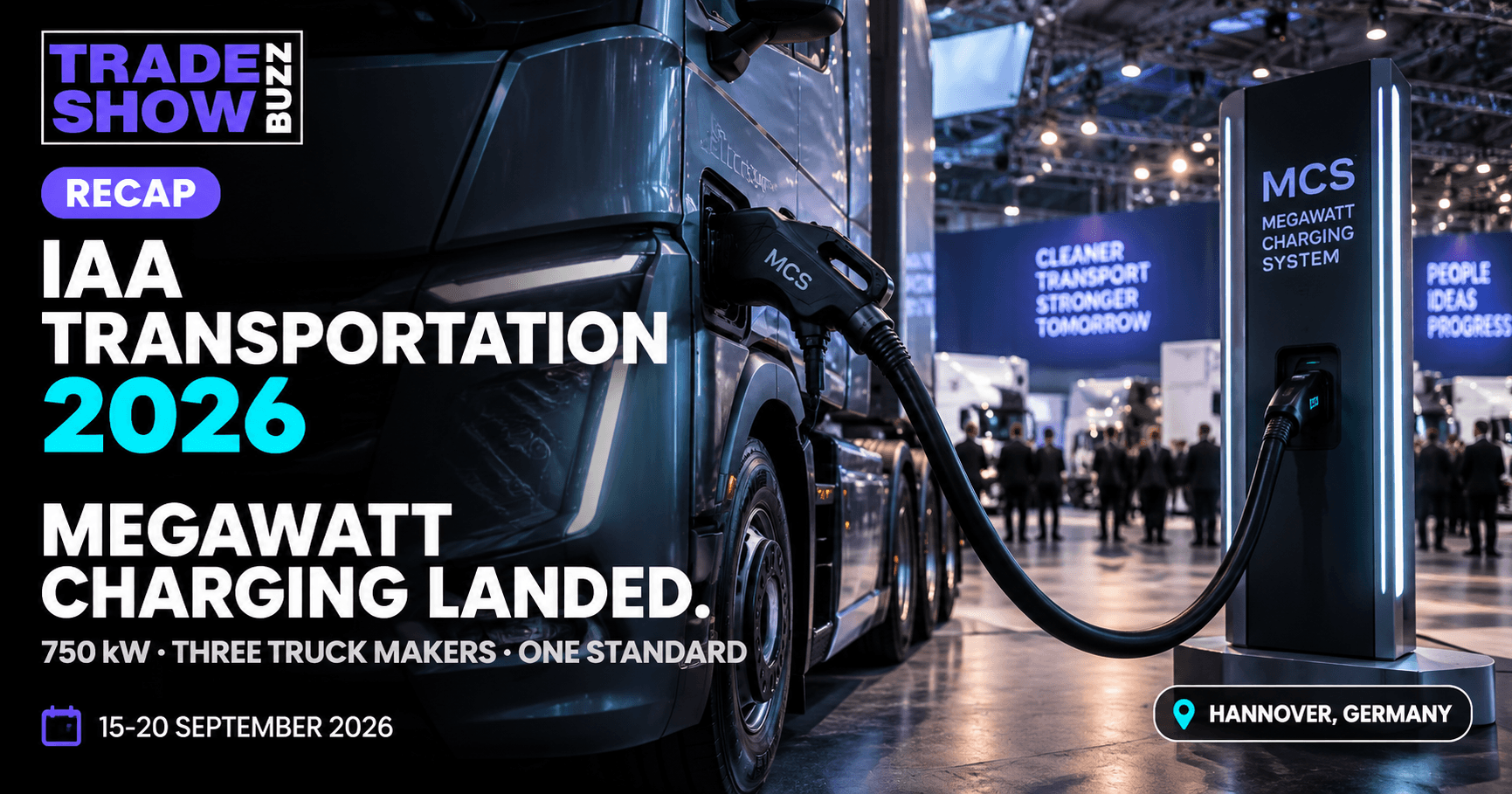
September 15-20, 2026 | Deutsche Messe Hannover, Germany | 1,589 exhibitors from a record 46 countries | 140,000+ visitors, including 113,000+ weekday trade professionals | 40% international trade visitors | 150+ world premieres and new products | 8,500 test drives across 84 vehicles | Next edition: September 19-24, 2028
IAA Transportation 2026 closed on Sunday afternoon with the VDA calling it a record, and it was one. Just not the record most of the coverage implied.
The show finished with 1,589 exhibitors from 46 countries and more than 140,000 visitors, of whom more than 113,000 were industry professionals attending on weekdays. In its closing release, the VDA described the edition as setting "a new record for international participation" and noted that the weekday trade audience was "a slight increase compared with IAA 2024."
Both statements are accurate. Read them carefully and you get the actual shape of the week: a smaller, more international exhibitor base selling to a slightly larger and considerably more international professional audience.
Our IAA Transportation 2026 guide, published in August, carried the organizer's pre-show line that exhibitor registrations were running roughly 11% ahead of the equivalent point in the 2024 cycle. The final count came in about 6% below 2024. Both can be true, because an early-cycle registration comparison is a snapshot rather than a forecast, and that is the lesson worth carrying into your own 2028 planning: book against closing figures, not against the momentum number a show publishes in January.
The Record Is Real. It Is Not the Exhibitor Count.
Here is the arithmetic the headlines skipped.
| Metric | 2022 | 2024 | 2026 |
|---|---|---|---|
| Exhibitors | 1,402 | nearly 1,700 | 1,589 |
| Countries represented | 41 | 41 | 46 |
| Total visitors | not stated in closing release | ~145,000 | 140,000+ |
| World/European premieres | - | 145+ | 150+ |
| Test drives | ~7,500 | 6,300+ | 8,500 |
The VDA's own 2024 closing release put that edition at "nearly 1,700 exhibitors from 41 countries," a 21% jump on 2022, with visitor numbers "approximately 145,000."
So IAA Transportation 2026 fielded roughly 6% fewer exhibiting companies than 2024 and about 5,000 fewer total visitors, while adding five more countries to the exhibitor roster. The record is one of breadth, not volume. The VDA worded it precisely, and it is a genuine achievement: 46 countries is the most the show has represented. But an exhibitor budgeting for 2028 on the assumption that the floor is still expanding at the 2024 rate is working from the wrong slope.
The more interesting split is inside the visitor number. Weekday trade attendance rose slightly, to 113,000+. Total attendance fell, to 140,000+. The VDA has not published a separate weekend figure, but a rising weekday number inside a falling total strongly suggests most of the decline came from the public-facing Drivers and Family Weekend on 19 and 20 September rather than from the commercial audience. For anyone exhibiting to fleets rather than to enthusiasts, the audience that matters was flat to marginally up. That is a meaningfully better result than "attendance fell 3%" suggests, and it is the number to quote internally.
A Caution on the Percentages
One figure deserves a flag, because it will otherwise get repeated into a trend that may not exist.
The VDA's 2026 release states that international attendees "accounted for a record 40 percent of trade visitors, up from 34 percent in 2024."
The VDA's own 2024 release states that "the share of international trade visitors rose significantly to over 45%."
Those are the same organization describing the same edition two years apart, and they do not reconcile. We have not found a published methodology note explaining the restatement, and we are not assuming bad faith: definitions of "trade visitor" and "international" get revised, and a cleaner counting method applied consistently across both years is a perfectly ordinary reason for a number to move. But it does mean the 34% to 40% improvement should be treated as an internally consistent series rather than as a comparison you can safely make against anything the show published in 2024.
The practical guidance: where absolute counts are available, use those for cross-edition comparisons, and treat the percentage series cautiously.
What did move cleanly, and what exhibitors should care about more than the internationality split, is the quality of the room: 77% of trade visitors influence purchasing and procurement decisions, up from 71% in 2024. A smaller floor with a higher concentration of buyers is not a bad trade. It is arguably the better one, and the rest of those numbers are in the exhibitor section below.
China Came to Hannover in Force
The structural story of this edition was not German, and it was not about a powertrain.
The VDA noted that among international exhibitors, "companies from China, Turkey, and Italy had a particularly strong presence this year." That is the diplomatic version. China Daily reported the specific one: more than 300 Chinese companies exhibited in Hannover, against 70 in 2022, and they moved from peripheral booths into core hall space.
We have not been able to verify the 300 figure against a European or organizer source, so treat it as the Chinese trade press's count rather than an audited number. If it is accurate, Chinese companies accounted for roughly one in five of the show's 1,589 exhibitors.
The significant point is not the count. It is that the pitch has moved from export and display toward European localization:
- BYD confirmed its first heavy truck for the European market in 2027, with European production to follow. "In the long run, all products we sell in Europe will be locally produced," said Stella Li, BYD's Executive Vice-President.
- Foton announced a European technical center and local assembly by 2028, targeting 40% overseas sales by 2030, and marked its 13 millionth vehicle globally.
- Sinotruk showed a Sitrak battery-electric tractor with a 600 kWh pack, 500+ km of claimed range and Level 2 ADAS: a mainstream long-haul specification rather than a niche one.
- Pony.ai and GAC unveiled a Gen-4 Level 4 robotruck whose autonomous driving kit costs 70% less than the previous generation, with a projected 30% cut in per-tonne-kilometer transport cost and volume production scheduled to start later this year.
Dongfeng, FAW Jiefang and Skyworth Auto covered hydrogen, multi-powertrain and Level 4 autonomy respectively, so the breadth was there too. The context underneath: China's commercial vehicle exports topped a million for the first time in 2025 at 1.06 million units, and ran to 905,000 units in the first eight months of 2026 alone, up 38.1% year on year.
The counterweight, and it is a real one: electrive's floor analysis counted roughly a dozen Chinese brands showing vehicles and noted that most remain pre-homologation and without established European sales and service networks. A 600 kWh tractor on a stand in Hannover is not the same thing as a truck a Dutch fleet can buy, finance, insure and get fixed in Lyon on a Tuesday. That gap is the entire defensive position of the European incumbents, and it is narrowing rather than closed.
electrive's verdict on the mood among those incumbents was blunter than anything in the official releases: "The old arrogance is gone."
Megawatt Charging Was the Thing That Actually Worked
If one demonstration justified the trip, it was on Press Day, and it was not a vehicle.
Daimler Truck, MAN Truck & Bus and Scania joined the charging operator Milence to run an interoperable Megawatt Charging System demonstration: trucks from three competing manufacturers, charging on shared infrastructure, to 80% or fully charged inside the legally mandated 30 to 45 minute driver rest break.
That is the number that changes the operating model. Long-haul battery-electric trucking has never been blocked by range alone. It has been blocked by the fact that recharging consumed time the tachograph was not going to give back. Charging inside the mandatory rest break removes one of the biggest scheduling penalties separating battery-electric long-haul operation from diesel. Charger availability, routing, depot infrastructure, payload and energy pricing all still apply, but the clock-time argument is the one that just got answered in public.
The manufacturers said as much, in unusually concrete terms.
"MCS charging technology is the key to the cost-effectiveness and widespread adoption of battery-electric lorries in long-haul transport. With charging times shorter than the driver's rest break, the MAN eTGX can achieve daily ranges of over 1,000 kilometres within the same working hours as a diesel lorry," said Jürgen Wagner, Senior Vice President Engineering Vehicle & External Engines at MAN Truck & Bus. He added that MAN has been fitting MCS charging hardware as standard since July for customers who want to adopt early.
On the headroom, Lars Gustafsson, SVP and Head of Solutions Management at Scania: "With 1,000 amps and 750 kW as a starting point, MCS has the potential to exceed 3 MW as the technology develops."
And on readiness, Anja van Niersen, CEO of Milence: "Megawatt Charging is ready for real-world electric trucking today. At IAA TRANSPORTATION, we are demonstrating interoperable megawatt charging across trucks from different manufacturers."
Interoperable is the operative word. A fleet running mixed marques needs one charger to serve all of them, and this demonstration is the first time three major European truck makers have shown that working on the same hardware in public.
And Then the Infrastructure Number
The VDA put the counterweight in its own press release, which is to its credit, because it is brutal.
Europe will need around 35,000 publicly accessible MCS fast charging points by 2030. Today, in the words of VDA Managing Director Jürgen Mindel, "there are just 730 charging points across the EU with a minimum power output of more than 350 kW available exclusively for heavy-duty commercial vehicles."
Those two figures are not perfectly like for like, since today's 730 are high-power CCS points rather than MCS. But the VDA set them side by side deliberately, and the comparison is stark: the 35,000-point target is roughly 48 times the size of today's 730-point dedicated high-power network, and Europe has four years to close that gap. That is not a rollout. That is a construction program with a deadline attached, and nothing announced in Hannover changes who has to pay for it.
"Expanding charging infrastructure and power grids must therefore be the top priority now," Mindel said.
VDA President Hildegard Müller sharpened that into a policy demand in the closing release: "Now Berlin and Brussels must deliver. Successfully scaling up alternative powertrains requires vehicles, infrastructure, and competitive energy prices to work together." Her specific ask was that the EU stop penalizing manufacturers for a shortfall they do not control: "Brussels must also face the realities, base its decisions on data and facts, and eliminate financial penalties once and for all. The principle is clear: No penalties for policy failures."
It is a self-interested argument. It is also arithmetically hard to dismiss while the charging network stands at 730 points.
Behind the infrastructure complaint was a regulatory one, and it broke during the show. On Press Day, the chief executives of seven of Europe's largest truck and bus makers - DAF, Daimler Truck, Ford Otosan, Iveco, MAN, Scania and Volvo Group - issued a joint call for a three-year delay to EU compliance with the 2030 heavy-duty CO2 targets. Under Regulation (EU) 2019/1242 as amended in 2024, manufacturers must cut average CO2 emissions from new heavy-duty vehicles by 45% from 2030, 65% from 2035 and 90% from 2040. The reductions are measured against EU-average emissions in defined reference periods that vary by vehicle group, rather than against present-day emissions, which is why the 2030 target is steeper in practice than it sounds. Non-compliance carries an excess-emissions premium of EUR 4,250 per gCO2/tkm, and the manufacturers put their own exposure from missing the 2030 target by three percentage points at around EUR 2.2 billion. "The investments have been made, and a wide range of CO2-free vehicles is available today," they argued. "But making them commercially viable at scale also depends on the wider ecosystem that is clearly delayed."
That is what turns the charger gap from a talking point into a live policy fight, and it is what makes Müller's "No penalties for policy failures" line intelligible rather than merely combative. It also produced the week's sharpest internal tension: on the same day, three of those seven manufacturers stood on the same pad and demonstrated that the technology works.
The market numbers say the same thing from the other direction. Per ICCT data for Q1 2026, zero-emission vehicles took 2.3% of European heavy truck registrations above 12 tonnes, up from 1.4% a year earlier: roughly 1,600 units against 900. Real growth, nearly doubling, but still a very small share of the heavy-truck market. In the medium-duty segment, 3.5 to 12 tonnes, the picture is transformed: 19.7% zero-emission, close to one in five.
So the honest state of play coming out of Hannover is that the medium-duty market is moving fast while the heavy-duty market has not yet tipped. At the heavy end, vehicle availability is now running ahead of the infrastructure needed to operate those vehicles at scale.
What the Truck Makers Actually Launched
More than 150 world premieres and new products were presented. The ones that will still matter in 2028:
Daimler Truck covered all three powertrain bets in the same week. The eActros Lowliner solves a specific freight problem, lowering the fifth wheel so mega trailers get full interior height, in 400 and 600 versions with roughly 500 km of range at full load on the larger pack; orders open Q3 2026, production at Wörth from Q2 2027. The NextGenH2 Truck runs liquid hydrogen through cellcentric's BZA150 fuel cell for more than 1,000 km per fill, with around 100 units entering customer operation in Germany from the end of 2026 and Dachser as the first customer - the hydrogen program's first genuine commercial test rather than another prototype lap. And the Powerliner, a new diesel drivetrain claiming up to 4% fuel savings from April 2027, was a reminder that in a week of electric headlines the incumbent still shipped a diesel efficiency program. Daimler also claims a 38% share of the European CO2-free heavy and medium-duty truck market in H1 2026.
MAN brought the eTGX to production form at up to 660 km as a 4x2 and 720 km as a 6x2 with a seventh battery pack, and, per its own MCS comments above, is already fitting megawatt charging hardware as standard for early adopters.
Volvo Trucks showed the new electric FH, FH Aero, FM and FMX range that had already taken the year's biggest award, with the FH Aero Electric claiming up to 700 km. Scania brought four battery-electric trucks with its international long-haul configuration quoted at up to 720 km.
The significant thing about those three numbers is that they converge. Europe's big three have landed on roughly the same 700-plus kilometer headline range within one product cycle. Those figures are not necessarily measured under identical payloads or duty cycles, so 700 against 720 does not establish practical parity. But it does make range alone a less useful differentiator at the top of the market, and pushes charging access, payload, service coverage and total cost forward as the terms of the argument.
Tesla displayed a European-specification Semi without a sleeper cab or a CCS port, which reads as a play for specific large customers rather than the general market. On the supplier side, CATL showed a commercial vehicle battery claiming up to 1,000 km of range.
One absence is worth naming, and electrive named it: for a show whose central argument was that Europe urgently needs grid capacity and charging corridors, the energy sector itself was barely represented on the floor. Everyone called for the infrastructure. Almost nobody who builds it had a stand.
The Stars of the Year Awards
The Stars of the Year Awards were presented on Press Day, 14 September.
- International Truck of the Year 2027: Volvo Trucks, for the new electric FH, FM, FMX and FH Aero Electric range. The 24-member jury cited range, breadth of application, energy efficiency and operational flexibility. Jury chairman Florian Engel: "With its new electric range, Volvo Trucks demonstrates how quickly battery-electric heavy-duty transport is evolving from individual applications into a comprehensive transport solution."
- Truck Innovation Award 2027: ZF, for TraXon Hybrid, which integrates hybrid drive directly into a proven heavy-duty transmission architecture.
- International Van of the Year 2027: Renault, for the fourth-generation Trafic E-Tech Electric. Second went to the Stellantis ProOne Compact Van; the Farizon V7E and the Volkswagen Caddy Cargo shared third. A Chinese-owned brand taking a podium place at the European van award is a small result with a large direction of travel attached.
- International Trailer Award 2027, across five categories: Schmitz Cargobull (Body, S.KO CITY with S.CU MT-DUALEVAP), Kögel (Chassis, KÖGEL LIGHT PLUS, optimized for electric tractors), Kässbohrer (Components, Modular Floor System K.MFS), Krone (Future, TrAIler Health Monitoring System) and, in the first running of the community-voted category, Turkey's Koluman (Adaptive Hidden Sidewall Platform Trailer).
Hall 22 also carried the International Truck of the Year 50th Anniversary Exhibition, with around 20 winning trucks spanning five decades.
Test Drives Were the Format Story
The detail most likely to get copied by other shows was operational rather than technological.
IAA ran 84 test-drive vehicles from 17 exhibitors, up from 60 vehicles in 2024, and logged 8,500 test drives, a 32.5% increase. More importantly, a new hall concept let MAN Truck & Bus and Volvo Trucks run test drives directly from their own stands rather than routing visitors to a separate test area.
That is a significant change to how a commercial vehicle stand converts. The friction in a test-drive program has always been the walk: a visitor who has to leave your booth, cross the grounds and queue at a shared facility is a visitor you have handed to the schedule rather than to your sales team. Removing that step keeps the demonstration inside the conversation.
One caveat on the growth figure for anyone benchmarking. The published test-drive series does not reconcile cleanly across editions. The 2024 release reports "over 6,300 test drives, more than 2,200 on the cargo-bike course, and over 450 in the driving school," which can be read as either an inclusive or an additive total, and calls the result "nearly 15 percent above the previous IAA TRANSPORTATION record" even though the 2022 closing report put that edition at "around 7,500 test drives." Whichever reading is intended, "8,500 test drives" in 2026 is not 8,500 people driving a heavy truck, and the 2026 breakdown has not been published. Ask the organizer for the segmented numbers before you build a 2028 business case on them.
What It Means for Exhibitors
Three things carry into 2028.
Do not budget on continued exhibitor growth. 2024 grew the exhibitor base 21% on 2022; 2026 broke that trajectory, coming in about 6% below 2024. One down edition is not a trend, and it would be wrong to project a decline from it. But it does retire the assumption that space at this show gets harder to obtain every cycle, and that assumption is what inflates early booking decisions. The composition question is the live one: with 46 countries represented and Chinese participation rising sharply, who is standing next to you in 2028 is a more useful thing to plan around than how much floor is left.
The audience stayed commercially strong despite lower total attendance. 77% of trade visitors influence purchasing and procurement decisions, up from 71% in 2024; 52% plan to invest in commercial vehicles within six to 12 months, with a further 17% considering it; satisfaction ran at 92% and 88% said they would return. Total footfall is the wrong metric to judge this edition on, and it is the one most likely to appear in an internal post-mortem.
The Netherlands, Denmark and Sweden warrant disproportionate attention in 2028 planning. They are the top three markets for zero-emission heavy truck registrations, at 10.3%, 10.0% and 9.7% share respectively against a European average of 2.3%. The Netherlands is the particularly interesting case: it led European zero-emission heavy-truck penetration and was also the largest single source of international trade visitors in Hannover, so the buying and the attending line up in one market. Denmark and Sweden's near-10% adoption rates make them useful secondary markets to test against your own customer data rather than a proven overlap.
Next Edition
IAA Transportation 2028 runs 19-24 September 2028 at Deutsche Messe Hannover, with Press Day on Monday 18 September 2028.
The commercial vehicle calendar does not pause for two years in between. The same venue hosts Hannover Messe each spring, and on the automotive side, Automechanika Frankfurt 2026 covered the aftermarket and repair end of the same industry a week before IAA opened. You can browse the rest on our Hannover and Logistics & Transport pages.
Frequently Asked Questions
When was IAA Transportation 2026 held? IAA Transportation 2026 ran Tuesday 15 September through Sunday 20 September 2026 at Deutsche Messe Hannover in Germany, preceded by a Press Day on Monday 14 September. It is a biennial show held in even-numbered years, organized by the VDA, the German Association of the Automotive Industry, and was formerly known as IAA Commercial Vehicles.
How many people attended IAA Transportation 2026? More than 140,000 visitors attended in total, including more than 113,000 industry professionals on weekdays. The VDA described the weekday trade audience as a slight increase on 2024, while total attendance was down from approximately 145,000 in 2024. Because weekday trade attendance increased slightly, the available figures suggest most of the decline came from the public Drivers and Family Weekend, though the VDA has not published a separate weekend count. International attendees made up a record 40% of trade visitors, with the Netherlands, China and Poland the most strongly represented countries.
How many exhibitors were at IAA Transportation 2026? 1,589 exhibitors from 46 countries took part, which the VDA described as a new record for international participation. The 2024 edition had nearly 1,700 exhibitors from 41 countries, so 2026 had roughly 6% fewer exhibiting companies drawn from five more countries. China, Turkey and Italy had the strongest presence among international exhibitors.
What was announced at IAA Transportation 2026? More than 150 world premieres and new products were shown. The headline launches were Mercedes-Benz Trucks' eActros Lowliner, a battery-electric tractor with a lowered fifth wheel for mega trailers, and its NextGenH2 liquid-hydrogen truck, which goes into customer operation in Germany from the end of 2026 with Dachser as first customer. MAN brought the eTGX to production form, Volvo Trucks showed the new electric FH, FH Aero, FM and FMX range, and Scania showed four battery-electric trucks, with all three quoting roughly 700 to 720 km of range. Daimler Truck also launched the Powerliner diesel drivetrain. Chinese exhibitors including BYD, Sinotruk, Foton, Dongfeng and Pony.ai brought electric, hydrogen and Level 4 autonomous trucks, several with European localization plans attached.
What is megawatt charging and what happened at IAA Transportation 2026? The Megawatt Charging System (MCS) is a high-power charging standard for heavy trucks, starting at 1,000 amps and 750 kW. On Press Day, Daimler Truck, MAN Truck & Bus and Scania joined the charging operator Milence to demonstrate interoperable MCS charging across all three manufacturers' trucks, reaching 80% or full charge within the legally mandated 30 to 45 minute driver rest break. That removes one of the largest scheduling penalties on electric long-haul operation. The bigger constraint is now infrastructure: the VDA says Europe needs around 35,000 public MCS points by 2030, against 730 EU points above 350 kW reserved for heavy-duty vehicles today.
Why are European truckmakers asking to delay the EU 2030 CO2 targets? On Press Day at IAA Transportation 2026, the chief executives of DAF, Daimler Truck, Ford Otosan, Iveco, MAN, Scania and Volvo Group jointly called for a three-year delay to compliance with the EU's 2030 heavy-duty CO2 targets. Under Regulation (EU) 2019/1242 as amended in 2024, manufacturers must cut average CO2 emissions from new heavy-duty vehicles by 45% from 2030, measured against EU-average emissions in defined reference periods that vary by vehicle group, with an excess-emissions premium of EUR 4,250 per gCO2/tkm for non-compliance. Their argument is that the vehicles exist but the charging infrastructure, grid connections and energy prices needed to make them commercially viable at scale do not, so manufacturers would be penalized for a shortfall they do not control.
Who won the awards at IAA Transportation 2026? Volvo Trucks won International Truck of the Year 2027 for its new electric FH, FM, FMX and FH Aero Electric range. ZF won the Truck Innovation Award 2027 for TraXon Hybrid. Renault won International Van of the Year 2027 with the fourth-generation Trafic E-Tech Electric, ahead of the Stellantis ProOne Compact Van in second and the Farizon V7E and Volkswagen Caddy Cargo tied in third. The International Trailer Award 2027 went to Schmitz Cargobull, Kögel, Kässbohrer, Krone and Koluman across five categories.
When is IAA Transportation 2028? IAA Transportation 2028 runs 19-24 September 2028 at Deutsche Messe Hannover, with Press Day on Monday 18 September 2028.