
Canton Fair Autumn 2026: The Complete Guide to All Three Phases, Badges, Visas & Getting There
The 140th Canton Fair runs in three separate phases between 15 October and 4 November 2026 at the Canton Fair Complex in Guangzhou. Your guide to which phase covers your products, how the free buyer badge works, visa-free entry, and how to reach Pazhou.
| Detail | Info | Detail | Info |
|---|---|---|---|
| 📅 Dates | Phase 1: 15-19 Oct / Phase 2: 23-27 Oct / Phase 3: 31 Oct-4 Nov 2026 | 🏛️ Location | Guangzhou, Guangdong, China |
| 💡 Focus | General export sourcing: manufacturing, electronics, vehicles, home, building, gifts, textiles, fashion, toys, health, food | 🏢 Venue | China Import and Export Fair Complex, Pazhou, Haizhu District |
| 🔁 Frequency | Twice a year (spring and autumn) | 🌍 Exhibitors | Over 30,000 expected across the three phases |
| 👥 Last attendance | 314,000 overseas buyers from 220 countries and regions (139th session, spring 2026) | 🎟️ Access | Free buyer badge for overseas trade buyers, after online pre-registration |
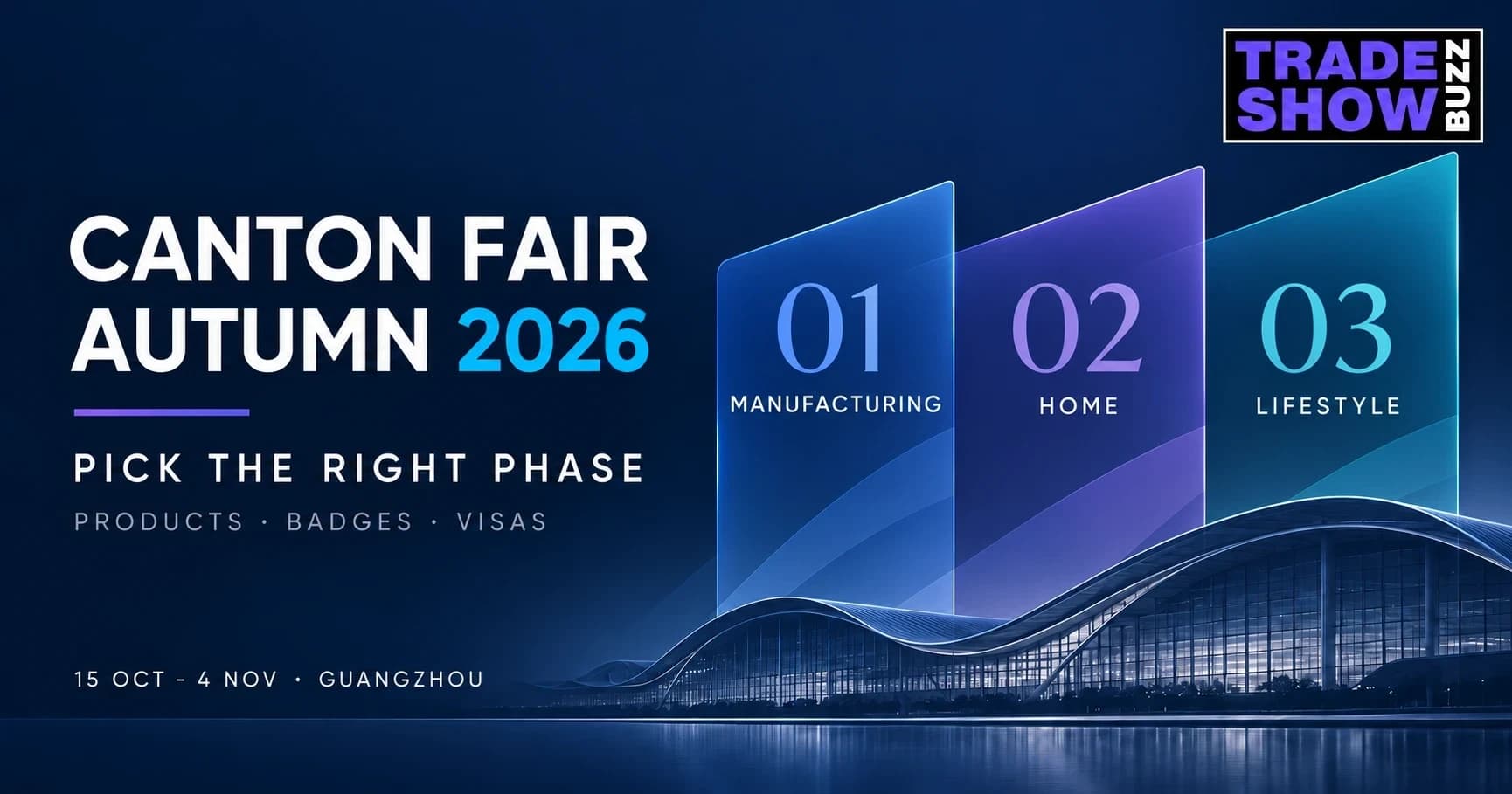
Quick Answer: When is the Canton Fair Autumn 2026 and what is it? The autumn 2026 Canton Fair is the 140th session of the China Import and Export Fair. It runs in three separate phases at the China Import and Export Fair Complex on Pazhou Island, Guangzhou: Phase 1 (15-19 October) covers advanced manufacturing, electronics, machinery, vehicles, lighting, hardware and tools; Phase 2 (23-27 October) covers home products, building materials, furniture and gifts; Phase 3 (31 October-4 November) covers textiles, fashion, toys, baby products, food, health and personal care. The halls are empty on 20-22 October and 28-30 October while one phase is struck and the next is built. Entry is by a free buyer badge for overseas trade buyers who pre-register online. The organizer expects more than 30,000 exhibitors on 1.55 million square meters. The spring 2026 session drew 314,000 overseas buyers from 220 countries and regions.
Pick your phase before booking flights. Each phase has its own product sections and its own exhibitors, and most buyers only need one. Visiting all three means roughly three weeks in Guangzhou. The table below shows what each phase covers, and Section 2 has the full list of exhibition sections. For the structured listings, see our show pages for Phase 1, Phase 2 and Phase 3.
1. Dates and the Three-Phase Shape
The 140th session runs across three weeks, with two gaps:
| Phase | Dates | Theme | What it covers |
|---|---|---|---|
| Phase 1 | Thursday 15 - Monday 19 October 2026 | Advanced Manufacturing | Electronics and appliances, machinery, vehicles and two-wheelers, lighting and electrical, hardware and tools, new energy |
| Interval | 20-22 October | - | Phase 1 move-out, Phase 2 build |
| Phase 2 | Friday 23 - Tuesday 27 October 2026 | Quality Home Life | Housewares, gifts and decorations, building materials and furniture |
| Interval | 28-30 October | - | Phase 2 move-out, Phase 3 build |
| Phase 3 | Saturday 31 October - Wednesday 4 November 2026 | Better Life | Textiles and fashion, toys and baby products, home textiles, stationery, food, health and personal care, pet products |
The organizer publishes the schedule, section list and hall map in its 2026 Attendance Guide for Overseas Buyers, available in ten languages.
The intervals are dead days on the fair floor, but they are not wasted if you plan for them. Many buyers use the interval days for factory visits in the Pearl River Delta, and the organizer runs its own supplier trips (see Section 7). If your categories straddle two phases, say lighting (Phase 1) and home decorations (Phase 2), the 20-22 October gap is the natural time to visit factories before Phase 2 opens.
Daily hours. The organizer's 2026 buyer materials do not publish floor opening hours. Check the official website or the Canton Fair app for each phase's opening hours, and for the final day of each phase in particular.
2. Which Phase Covers Your Products
The organizer groups the 140th session into 13 product categories and 54 exhibition sections, plus themed zones. The lists below are taken from the organizer's 140th session announcement and its 2026 buyer guide. Themed zones are marked in bold.
Phase 1 - Advanced Manufacturing (15-19 October)
- Household Electrical Appliances
- Consumer Electronics and Information Products
- Industrial Automation and Intelligent Manufacturing
- Processing Machinery Equipment
- Power Machinery and Electric Power
- General Machinery and Mechanical Basic Parts
- Construction Machinery
- Agricultural Machinery
- New Materials and Chemical Products
- New Energy Vehicles and Smart Mobility
- Vehicles
- Vehicle Spare Parts
- Motorcycles
- Bicycles
- Lighting Equipment
- Electronic and Electrical Products
- New Energy Resources
- Hardware
- Tools
- Service Robots Zone
The Service Robots Zone returns for the 140th session. The organizer lists humanoid robots, robot dogs, dexterous robotic hands, companion robots, coffee robots, inspection robots, exoskeletons, and delivery and cleaning robots. A Smart Wearables Zone covers smart watches, VR glasses and AI translation devices. Phase 1 is also where drones, intelligent connected vehicles and new energy equipment sit.
Phase 2 - Quality Home Life (23-27 October)
- General Ceramics
- Kitchenware and Tableware
- Household Items
- Glass Artware
- Gardening Products
- Art Ceramics
- Weaving, Rattan and Iron Products
- Home Decorations
- Festival Products
- Gifts and Premiums
- Clocks, Watches and Optical Instruments
- Building and Decorative Materials
- Sanitary and Bathroom Equipment
- Furniture
- Prefabricated House and Courtyard Facilities
- Fashion Jewelry Zone
The organizer says Building and Furniture, Housewares, and Gifts and Decorations each take up more than 130,000 square meters in Phase 2. The Fashion Jewelry Zone is split into natural jewelry and jade, artificial and synthetic jewelry, and precious metal ornaments.
Phase 3 - Better Life (31 October-4 November)
- Toys
- Children, Baby and Maternity Products
- Kids' Wear
- Men and Women's Clothing
- Underwear
- Sports and Casual Wear
- Furs, Leather, Downs and Related Products
- Fashion Accessories and Fittings
- Textile Raw Materials and Fabrics
- Shoes
- Cases and Bags
- Home Textiles
- Carpets and Tapestries
- Office Supplies
- Food
- Medicines, Health Products and Medical Devices
- Personal Care Products
- Toiletries
- Sports, Travel and Recreation Products
- Pet Products and Food
- Rural Vitalization
- Intelligent Healthcare Zone
The Intelligent Healthcare Zone covers six product types: intelligent diagnostic and medical equipment, medical robots, smart monitoring, smart wearables, intelligent physical therapy, and smart rehabilitation.
The International Pavilion (Phases 2 and 3)
Not every exhibitor is Chinese. The fair's International Pavilion brings overseas exhibitors into Phase 2 (23-27 October) and Phase 3 (31 October-4 November) only. In Phase 2 it covers ceramics, household items, kitchenware, home decorations, festival products, gifts, glass artware, clocks and watches, gardening products, and weaving, rattan and iron products. In Phase 3 it covers clothing, shoes, bags, textiles and fabrics, home textiles, food, personal care, health products, pet products, office supplies, toys and baby products. There is no International Pavilion in Phase 1. Overseas companies that want to exhibit apply through the pavilion's own page.
Two traps to avoid. Home textiles are in Phase 3, not Phase 2, even though they feel like "home." Furniture is Phase 2, but lighting is Phase 1. If you are sourcing for a furniture or interiors brand, you may need both.
Search before you fly. The official website and the Canton Fair app list exhibitors by the same sections as the physical fair, and they run all year. Filtering by section, product category and company type, then saving booths to your itinerary, is the fastest way to turn 30,000 exhibitors into a shortlist.
3. What the Canton Fair Actually Is
The China Import and Export Fair has been held every spring and autumn in Guangzhou since 1957. It is co-hosted by China's Ministry of Commerce and the People's Government of Guangdong Province, and organized by the China Foreign Trade Centre. The autumn 2026 edition is the 140th session. The "Canton" in the name is the old English name for Guangzhou.
It is not a trade fair in the sense most European or American visitors are used to. Three things make it different:
- It is a general export fair, not an industry fair. There is no single sector. Over three weeks the floor covers everything from construction machinery to kids' wear to pet food. The organizer calls it a "comprehensive" fair, and that is literal.
- It is three shows sharing one building. Product sections and exhibitor lineups change between phases. A furniture buyer who turns up in Phase 1 will find machinery and electronics.
- The exhibitors are overwhelmingly Chinese manufacturers and trading companies. The fair's main purpose is selling Chinese exports to overseas buyers, although overseas companies also exhibit in the International Pavilion (see Section 2). The organizer says about 2,800 of the 30,000-plus exhibitors are "Canton Fair brand exhibitors" selected through its own evaluation, and around one third are companies with national high-tech or specialist-manufacturer status.
The scale is real. The 138th session (autumn 2025) reported more than 310,000 overseas buyers from 223 countries and regions, a record at the time, and $25.65 billion in intended export deals. The 139th session (spring 2026) then drew 314,000 overseas buyers from 220 countries and regions. The exhibition area has been held at 1.55 million square meters across recent sessions, and the 140th uses the same figure.
If you have been to our coverage of MWC Shanghai 2026 or read how Chinese manufacturers took floor space at IAA Transportation 2026, the Canton Fair is the other end of the same story: instead of Chinese companies going to overseas shows, the buyers come to them.
4. Registration and Your Buyer Badge
The buyer badge is free. The organizer's own guidance for overseas buyers states that applying for, replacing or renewing a badge is free of charge. Some third-party sites still quote on-site badge fees. They are out of date. The organizer also warns that it has never authorized any third party to provide badge services, and that no charges apply beyond what it announces itself. Ignore anyone offering to "arrange" a badge for a fee.
Step 1 - Pre-register online. Pre-registration is open all year on the official website, through the Buyer Service System, and in the Canton Fair app. You create an account with an email address, select your identity (for example, a foreign passport holder), and fill in your company details. The organizer asks all overseas buyers attending on site to pre-register.
Step 2 - Collect the badge away from the complex. Once pre-registered, you can collect your badge at an alternative registration office, and the organizer encourages you to do exactly that rather than queuing at the venue. The organizer's 140th session announcement confirms these locations:
- Guangzhou Baiyun International Airport - at the spring 2026 session the airport registration office was at the exit of the International Arrivals Hall in Terminal 3, near Gate 74
- Guangzhou South Railway Station - the high-speed rail hub, including trains from Hong Kong
- Pazhou Ferry Terminal - the Hong Kong-Macao passenger ferry terminal next to the fair
- Designated hotels in Guangzhou - there were 60 at the spring 2026 session, and the organizer publishes each session's list on its website
- The Canton Fair Hong Kong Representative Office - Wan Chai, Hong Kong, on business days year-round
Exact desk locations and opening hours for the 140th session are published on the official website shortly before the fair.
There are also registration offices at the complex itself, next to Areas B, C and D.
What to bring. Your original, valid passport (or other eligible travel document) and a business card. Photocopies are not accepted.
Who counts as an overseas buyer. Foreign passport holders; holders of Mainland Travel Permits for Hong Kong, Macao and Taiwan residents; and Chinese passport holders with an overseas permanent residence permit or permanent residence visa. Chinese passport holders in that last group must register at the complex rather than the alternative offices.
The badge itself was redesigned for the 139th session. It now carries QR codes for the Canton Fair app and for ASKME, the organizer's AI assistant for searching exhibitors and products.
New for the 140th session: Overseas Buyer Membership. Every registered overseas buyer is enrolled automatically, with no separate application. Buyers earn points for pre-registration, on-site attendance, keeping their profile up to date and joining events, and move through four permanent tiers. Points can be redeemed for souvenirs, transit services, vouchers and other services, and redeeming them does not lower your tier.
5. Visas and Entry to China
China's entry rules have loosened a great deal since 2024, and for many buyers the Canton Fair no longer requires a visa. Check the rules for your own passport before you book, because the lists change.
30-day visa-free entry. China's unilateral visa exemption lets ordinary passport holders from 50 countries enter for up to 30 days for business, tourism, family visits, exchanges or transit. The list covers most of Europe, plus Australia, New Zealand, Japan, South Korea, Brunei, Saudi Arabia, Oman, Kuwait, Bahrain, Argentina, Brazil, Chile, Peru and Uruguay, and was extended to Canada and the United Kingdom from 17 February 2026. Check your passport against the National Immigration Administration's list of countries covered by unilateral visa exemption. The current program runs through 31 December 2026, so it covers the whole autumn session, and 30 days is enough to attend all three phases.
240-hour visa-free transit. If your country is not on the 30-day list, you may still qualify for visa-free transit. As of the National Immigration Administration's 20 August 2026 update to its visa-free transit rules, nationals of 57 countries, including the United States, Mexico and Indonesia, can stay up to 10 days when transiting through China to a third country or region, entering through one of 65 designated ports in 24 provinces. Two conditions matter for Canton Fair visitors:
- You must hold a confirmed onward ticket to a third country or region, different from the one you flew in from. A simple return trip home does not qualify. Flying in from your home country and out to Hong Kong, or vice versa, is the common way to meet it.
- Ten days covers one phase comfortably, not all three.
If neither applies. If neither a visa exemption nor visa-free transit covers your itinerary, check the visa requirements for your passport with your nearest Chinese embassy or consulate. If you need a business (M) visa, pre-registered buyers can request an official invitation letter from the organizer through its buyer services system to support the application. Allow time for this: invitation letters and visa appointments are the most common reason first-timers miss a phase.
6. Getting to the Complex
The venue. The China Import and Export Fair Complex, No. 382 Yuejiang Zhong Road, Haizhu District, Guangzhou, sits on Pazhou Island on the south bank of the Pearl River. It is split into four areas: Area A (Halls 1-8), Area B (Halls 9-13), Area C (Halls 14-16) and Area D (Halls 17-20). Areas A and B face the river along Yuejiang Zhong Road; Area C sits south across Xingang Dong Road; Area D is at the western end. See our China Import and Export Fair Complex venue page for the listing.
By metro. Two stations serve the complex:
- Xingangdong Station (Line 8) - Exit A for Area A
- Pazhou Station (Line 8 and Line 11) - Exits A and B for Area B, Exit C for Area C, and Exit E from Line 11
Line 8 is the one to plan around. It crosses Line 3 at Kecun, which is how most visitors from the Tianhe hotels and the airport connect.
From Guangzhou Baiyun International Airport. The airport now runs from Terminals 2 and 3. Terminal 1 closed on 7 May 2026 when its airlines moved to Terminal 3, and the metro station linked to it is suspended. Check your terminal before you plan the ride:
- Terminal 3: there is no metro station at the terminal. Take the airport shuttle bus from the T3 transport hub to Gaozeng Station (about 15 minutes, 2 yuan), then Metro Line 3 south.
- Terminal 2: Metro Line 3 runs from the terminal.
Ride Line 3 south toward Panyu Square, changing trains at Tiyu Xilu if yours terminates there, then change to Line 8 at Kecun for Xingangdong or Pazhou. Taxis and ride-hailing are straightforward but slow at peak hours.
Badge at the airport. If the 140th session's airport desk is operating when you arrive, collect your badge before heading to the shuttle. Check the official desk location and hours on the Canton Fair website first.
From Hong Kong. High-speed trains run from Hong Kong West Kowloon to Guangzhou South, with the fastest services taking around 47 minutes. There is a badge registration office at Guangzhou South. From there, take Metro Line 2 and change to Line 8 at Changgang. The other option is the ferry from Hong Kong to the Pazhou Ferry Terminal, which lands you next to the fair and also has a registration office.
Getting around between areas. The complex is large. Areas A and B are connected; Area C is across the road to the south; Area D is a long walk west. The organizer has installed an indoor positioning system for the 140th session, and the app offers booth-level navigation. Use it, and plan your route by area rather than by hall number.
7. Services Worth Using
The Canton Fair runs a longer list of buyer services than most trade fairs. Five are worth knowing about before you go.
Trade Bridge - China Industrial Sourcing Trip. The organizer takes buyers to industrial bases and industrial parks for one-on-one matchmaking with manufacturers, factory tours and production inspections. It is aimed at larger buyers, but applications are open to overseas buyers. This is the best use of the interval days if you want to see production rather than a booth.
Multinationals Sourcing Service. A dedicated sourcing area and customized matchmaking for large buyers, including Fortune Global 500 companies and retailers from the Deloitte Global Retail 250 ranking. Exhibitors are invited to set up in the on-site sourcing area to meet them.
Trade Service Zone. The 140th session sets up a Trade Service Zone grouping services for R&D and design, international logistics, and financial insurance. The organizer has also partnered with 11 financial institutions on financing, risk management and digital trade services for buyers.
The app. It is worth installing before you land. Beyond the exhibitor search, it handles badge application, itineraries, business card exchange, instant messaging with exhibitors, booth navigation and AI note-taking that summarizes your meeting notes. The ASKME assistant can search exhibitors and products and start chats with suppliers.
Intellectual property. The organizer runs a complaint service during the fair, with pre-show screening and on-site handling of IP disputes. If you are sourcing branded or patented designs, or you see your own design copied on a stand, this is the channel to use.
8. Practical Planning
Hotels. Book early. Hotel prices in Guangzhou rise sharply during each phase, and the closest hotels sell out first. The two practical bases are Pazhou (Haizhu District), which puts you within walking distance or one metro stop of the halls, and Zhujiang New Town (Tianhe District), which has more choice and is a short Line 3-to-Line 8 ride away. Staying at one of the designated badge hotels saves a trip.
Airline and travel partners. The organizer lists China Southern Airlines, Air China and Hainan Airlines as partner airlines with fare offers for buyers, and the Canton Fair International Travel Agency handles travel bookings.
Payments. China runs on mobile payments. Both Alipay and WeChat Pay let visitors link a foreign Visa or Mastercard, and setting them up before you fly saves trouble at the first taxi or lunch counter. Carry some cash as a backup.
Connectivity. Many overseas apps and services, including Google, WhatsApp and most Western social networks, do not work normally on Chinese networks. Sort out your connectivity before you arrive and download what you need in advance.
Weather. Guangzhou in mid to late October is still warm and humid, typically in the high 20s °C during the day. Early November is a little cooler and drier. Pack for heat outside and air conditioning inside.
Interpreters. Many exhibitors have English-speaking sales staff, but not all, and detailed negotiations on specifications or pricing go better with an interpreter. Book one in advance if you plan to negotiate seriously, and agree the day rate and working hours up front.
Business cards. Bring plenty. You need one to collect your badge, and exchanging cards is still the default at most booths, alongside the app's digital card exchange.
9. Planning Notes and Clashes
Hong Kong the week before. Two big Hong Kong sourcing events sit just before Phase 1. The HKTDC Hong Kong Electronics Fair (Autumn Edition) runs 13-16 October at the Hong Kong Convention and Exhibition Centre, and the Global Sources Hong Kong Shows run in two phases at AsiaWorld-Expo, 11-14 October and 18-21 October. Electronics buyers often combine Hong Kong with Canton Fair Phase 1, and the high-speed train or ferry makes the hop simple.
Food buyers and Paris. SIAL Paris 2026 runs 17-21 October, during Canton Fair Phase 1. Food buyers can do both: the Canton Fair's Food section is in Phase 3, which opens ten days after SIAL closes.
The rest of the calendar. For everything else running in October and November, see our October 2026 trade show calendar and November 2026 trade show calendar.
Spring 2027. The Canton Fair returns in spring, with the 141st session expected in April and May 2027. The organizer confirms dates closer to the time.
FAQs
When is the Canton Fair Autumn 2026? The 140th Canton Fair runs in three phases: Phase 1 from 15 to 19 October, Phase 2 from 23 to 27 October, and Phase 3 from 31 October to 4 November 2026. There is no exhibition on 20-22 October or 28-30 October.
Where is the Canton Fair held? At the China Import and Export Fair Complex, No. 382 Yuejiang Zhong Road, Pazhou, Haizhu District, Guangzhou, China. The nearest metro stations are Xingangdong and Pazhou on Line 8.
Which Canton Fair phase should I attend? Phase 1 covers electronics and appliances, machinery, vehicles and spare parts, lighting, hardware, tools and new energy. Phase 2 covers ceramics, kitchenware, household items, home decorations, gifts, building materials, sanitary ware and furniture. Phase 3 covers toys, baby products, clothing, shoes, bags, home textiles, office supplies, food, health products and pet products. Each phase has different exhibitors, and the International Pavilion for overseas exhibitors runs in Phases 2 and 3 only.
Is the Canton Fair free to attend? Yes, for overseas trade buyers. The buyer badge is free, and the organizer states that applying for, replacing or renewing a badge is free of charge. You need to pre-register online and bring your original passport and a business card to collect it.
Where do I collect my Canton Fair badge? After pre-registering, you can collect it at Guangzhou Baiyun International Airport, Guangzhou South Railway Station, Pazhou Ferry Terminal, designated hotels in Guangzhou, the Canton Fair Hong Kong Representative Office, or the registration offices at the complex. Exact desk locations for each session are published on the official website.
Do I need a visa for the Canton Fair? It depends on your passport. Nationals of the 50 countries in China's unilateral visa-free program, including most of Europe, Australia, New Zealand, Japan, South Korea, and since February 2026 the UK and Canada, can enter for up to 30 days through 31 December 2026. Nationals of 57 countries, including the United States, can use 240-hour visa-free transit with a confirmed onward ticket to a third country or region. If neither covers your itinerary, check the visa requirements for your passport. Pre-registered buyers can request an invitation letter from the organizer to support a business visa application.
How many people attend the Canton Fair? The 139th session in spring 2026 drew 314,000 overseas buyers from 220 countries and regions. The 138th session in autumn 2025 drew more than 310,000 overseas buyers from 223 countries and regions.
How many exhibitors are at the Canton Fair? The organizer expects more than 30,000 exhibitors at the 140th session across the three phases, on 1.55 million square meters of exhibition space.
How do I get to the Canton Fair from Hong Kong? Take the high-speed train from Hong Kong West Kowloon to Guangzhou South, which takes around 47 minutes on the fastest services, then the metro to Pazhou. Alternatively, take the ferry to Pazhou Ferry Terminal, next to the fair. Both arrival points have badge registration offices.